Search Results for: homeschool flexibility

Episode #17- Non-Profit Founder Discovers Homeschooling Equals Flexibility and Togetherness For Her Busy Family

Listen in to hear how Sabrina Johannes chose curriculum and settled into a homeschool routine, all while running a busy non-profit business and preparing for an overseas PCS to Germany.Pushed into it because of Covid, Sabrina Johannes has since gratefully discovered that homeschooling isn’t nearly as stressful as doing public school at home. This mom of two and founder of Deployed Love enjoys the flexibility and togetherness that homeschooling affords her busy family.


When Covid happened, Sabrina and her family found themselves doing public school at home but were dissatisfied with the school’s handling of the situation. So they decided to homeschool. At first unsure of where to start, Sabrina soon discovered that homeschooling was much less stressful than trying to do public school at home. Plus, they enjoy the flexibility and family time that homeschooling affords their family.


Listen in to hear how Sabrina Johannes chose curriculum and settled into a homeschool routine, all while running a busy non-profit business and preparing for an overseas PCS to Germany.


Sabrina Johannes is a veteran spouse and has been part of the military community for over 13 years. Currently homeschooling two kids (Kyra, 10, and Darren, 7) while also running a national non-profit. To say she’s busy is an understatement, but she thrives in the fact they can be flexible with school and find a schedule that best fits their family’s schedules. Sabrina and her family are in the midst of a PCS overseas to Germany.


Resources:


Join Crystal and her guests each week as they bring relevant information to equip you, stories to encourage you, and content to inspire you. You don’t have to go it alone; tune in to the Military Homeschool Podcast and be energized in your military homeschooling journey!


How to listen:

  1. Subscribe on Apple Podcasts, Google Podcasts, iHeartRadio, or Stitcher
  2. Subscribe on your favorite podcast listening app
  3. Or listen right here (just scroll down)


Got questions, comments, or have show topic ideas? Contact Crystal via email at militaryhomeschoolpodcast@gmail.com or connect with her on Facebook, Instagram, or Twitter.


Please subscribe, follow, and share with all of your military homeschooling friends!


Thank You to our Network Sponsor – CTC Math!

Can I Homeschool and Still Work?

Many families do. It works when you stop trying to run a school day and a work day in the same hours, and start building a week that admits both exist.

Homeschooling does not need business hours

This is the piece that unlocks it. School happens between eight and three because buildings and buses require it. Your family does not.

Early mornings before a shift. Evenings. Weekends. Four longer days instead of five. A schedule built around when you are actually available is not a compromised education, it is the normal one for working families.

Independence is the real currency

Every hour your child can work without you is an hour you get back. Build that deliberately and early.

For younger children, that means a short list they can do alone: copywork, a reading assignment, a math review page they already understand. For teens, it means handing over the planning itself. A capable fifteen-year-old with a weekly checklist does not need supervision, and learning to manage that list is itself worth more than most courses.

Use the people and tools available

Online classes, co-ops, tutors, a grandparent who takes one afternoon, a swap with another family. Outsourcing a subject is not a failure of nerve. It is how most working homeschool families cover the things that need live instruction while they are unavailable.

Be honest about the arithmetic

There is a real limit. A full-time job with no flexibility, no second adult, and four young children is extremely hard, and people who tell you otherwise are usually not doing it.

Look honestly at the hours before you commit, and be willing to adjust the plan rather than grinding yourself down inside one that does not fit.

Listen to this

It is our 13th birthday all month long.

The Ultimate Homeschool Podcast Network turns 13 this October, and we are giving away more than $1,500 in prizes across four drawings. One entry puts you in all of them, and everyone who enters gets Sweet Treats, a gathered-up collection of free resources from the hosts across the network.

Enter the Sweet 13 Giveaway

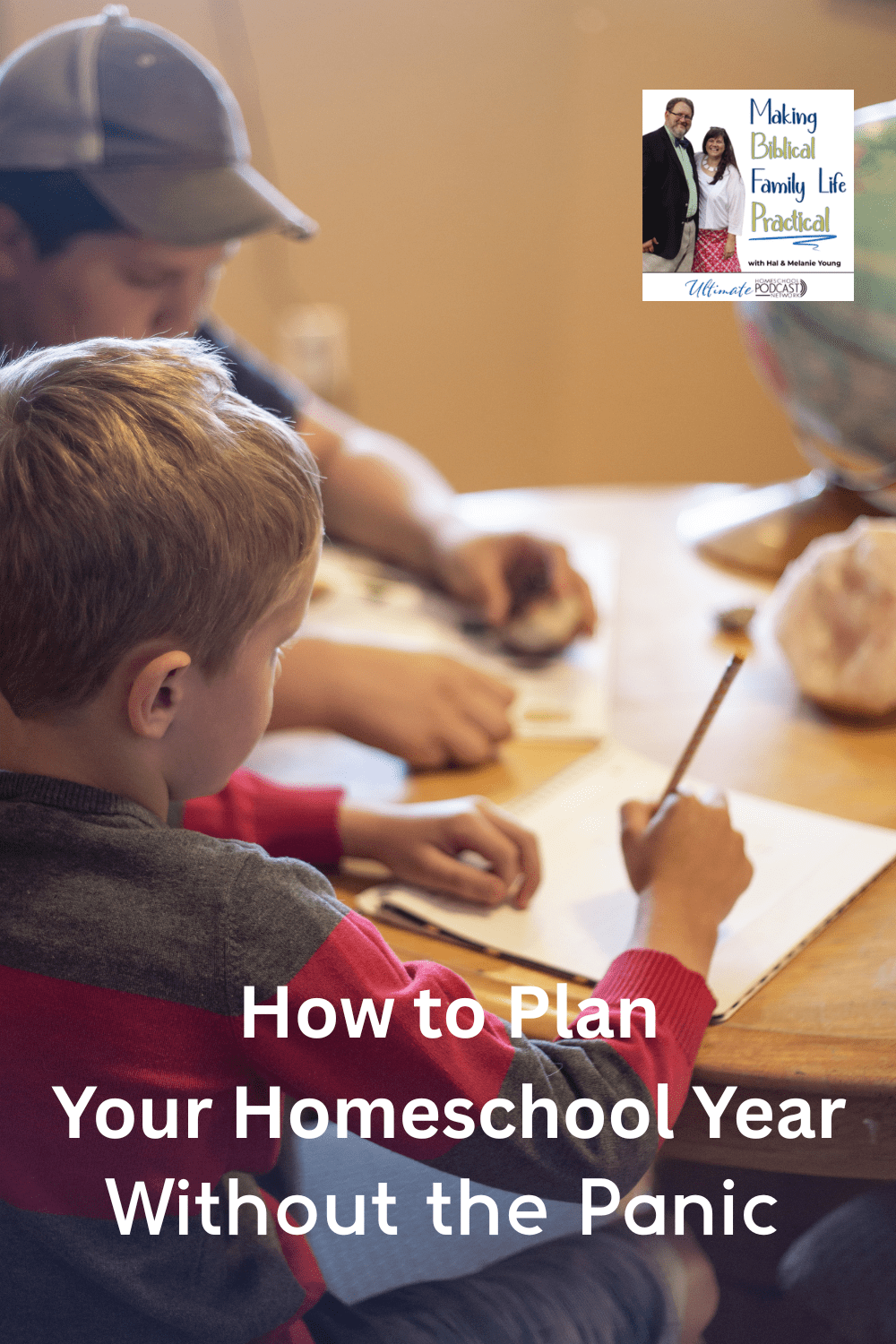
How to Plan Your Homeschool Year Without the Panic (Put the Big Rocks in First)

Hal & Melanie Young on planning your homeschool year the sane way: put the big rocks first, hold your plans with humility, and leave room for real life.It’s that time again — the planners are out, the curriculum catalogs are dog-eared, and the pressure is building. Before you map out every minute of the coming year, Hal and Melanie Young want to give you some relief, some freedom, and a whole lot of grace.

In this back-to-school favorite, Hal and Melanie share the planning approach that carried them through 25+ years and five graduates (all offered academic scholarships): plan well, but hold your plans with humility and flexibility. They walk through the “big rocks” principle — if you fill your jar with sand first, the important things never fit, so put the biggest rocks in first — and get honest about what those big rocks actually are.

In this episode you’ll hear:

  • The “big rocks” framework for planning a year — and why discipleship and character are the biggest rock of all, bigger than any curriculum choice
  • Melanie’s practical system: plan eight weeks of each quarter and leave one week blank to catch up; plan the week ahead, not every single day
  • Why “God’s curriculum is often different than ours” — and two family stories (a surprise trip to China, a baby in the ICU during AP season) where the interruption became the lesson
  • The tools of learning that matter most — reading, math, and writing, in that order — and how mastering them lets a child teach themselves almost anything
  • Grace for the early years: why you can do a lot of work orally with little ones (especially boys) and not panic over handwriting
  • How to make your curriculum your servant, not your master — read the teacher’s notes, follow the design, then adapt and trim the busywork (“busy work kills the love of learning dead”)
  • Freedom from the fear of “gaps,” and permission to grab the once-in-a-lifetime opportunity even when it’s not on the schedule

Whether you’re a brand-new homeschool mom terrified of choosing the “wrong” math, or a veteran feeling the August overwhelm, this one is a deep breath and a reset before you begin.

Resources mentioned:

  • Hal & Melanie Young — RaisingRealMen.com and HalandMelanie.com (see Shop → Struggling Learners for reading help)
  • Love, Honor, and Virtue — Hal & Melanie Young
  • The “big rocks” time-management illustration
  • Proverbs on the fear of the Lord as the beginning of wisdom; the Psalms on delighting to study the Lord’s works

Related listening (back-to-school): 👉 Homeschooling a Struggling Learner: Real Help When Nothing’s Working — a great companion if reading is your child’s sticking point this year.

Connect: RaisingRealMen.com · Facebook /RaisingRealMen · and if this encouraged you, leave the show a rating on Apple Podcasts.

This episode of Making Biblical Family Life Practical is part of the Ultimate Homeschool Podcast Network.

How to Start Homeschooling: A Step-by-Step Guide

How to Start Homeschooling — Homeschool Help Hub | Ultimate Homeschool Podcast Network

If you’ve found your way here, you’re probably somewhere between “could we really do this?” and “where do I even start?” Take a breath—homeschooling is more doable than it looks from the outside, and thousands of ordinary families start every single year without any special training. This guide walks you through it step by step.

Is Homeschooling Right for Your Family?

Families choose to homeschool for all kinds of reasons: a child who isn’t thriving, a desire to teach according to your own values and faith, flexibility for travel or health, or simply wanting more time together. You don’t need a “perfect” reason. If you love your kids and are willing to learn alongside them, you are qualified to homeschool—and you can always adjust as you go.

Step 1: Know Your State’s Homeschool Laws

This is the one non-negotiable first step. Homeschooling is legal in all 50 states, but the requirements—notices of intent, record-keeping, testing, or none of the above—vary a lot from state to state. Look up your specific state’s homeschool laws before anything else, so you start on solid ground.

Step 2: Give Everyone Time to Deschool

If your child is coming out of a classroom, resist the urge to recreate school at your kitchen table on day one. Take a few weeks to “deschool”—read together, bake, visit the library, follow curiosity. This helps both of you shed the classroom mindset. New homeschoolers who skip this step are the ones most likely to burn out early.

Step 3: Understand How Your Child Learns

One of homeschooling’s superpowers is that you can teach to your child instead of a class of thirty. Notice how they take in the world—stories, movement, hands-on projects, working independently—and lean toward what lights them up.

Step 4: Choose a Simple Approach (You Can Change Later)

There are many homeschooling styles—classical, Charlotte Mason, unit studies, traditional, eclectic, and unschooling among them. Don’t agonize over the “right” one. Read a short overview, notice what resonates, and start there. Most seasoned homeschoolers end up eclectic, borrowing what works from several approaches.

Step 5: Pick Curriculum—Without Overspending

It’s easy to panic-buy a full year of expensive boxed curriculum before you know what you need. Start lean. A solid math and language-arts program plus a library card carries you a long way early on, and you can add science and history through living books and read-alouds. For older students, our Homeschool Highschool Podcast covers credits, transcripts, and course planning.

Step 6: Build a Rhythm, Not a Rigid Schedule

Homeschool days rarely look like a school day—that’s a feature, not a bug. Aim for a predictable rhythm rather than a minute-by-minute schedule you’ll abandon by Tuesday. Younger children need far less seat time than you’d expect; a few focused hours is plenty.

Step 7: Find Your People

The number-one predictor of whether a family sticks with homeschooling is community. Look for a local co-op, park-day group, church group, or online community. This is also where the socialization question quietly answers itself—more on that in homeschool socialization. Our network of homeschool podcasts is here to encourage you on the hard days.

The Big Worries—Answered

“What about socialization?” Homeschoolers interact with people of all ages in real-world settings all week long. It’s the most-asked question and the least real problem.

“Am I smart enough?” You don’t have to know everything—just be willing to learn it with your child and use good resources.

“Will they get into college?” Homeschoolers are admitted to colleges of every kind every year. Keep simple records as you go and you’ll be in great shape.

You Can Do This

Start small, expect a messy first few weeks, and give yourself the same grace you’d give a brand-new teacher—because that’s exactly what you are.

🎧 Featured episode

I’m Thinking About Homeschooling, But…

From Homeschooling in Real Life — press play, then explore more episodes below.

Explore more guides in the Homeschool Help Hub →

🏡 Ready to take the first step?

Grab our free Christian Homeschool Starter Kit—three resources to help you plan your first year with confidence—and find encouragement from real homeschool families on our podcasts.

🛒 Need curriculum or resources? Shop Christian homeschool books, science, and unit studies from Media Angels.

Homeschooling High School Isn’t As Hard As You Think

🌿 This episode is proudly sponsored by Eden’s Table — a Christ-centered herbalism curriculum for K-5 homeschool families. One plant a week, woven through Bible, science, history, art, and Latin.

Try a free week →
📚 Part of our guide: Homeschooling High School

Does the thought of homeschooling high school make you feel panicked?

Maybe you’re wondering:

    • Will my teen be prepared for college?
    • What about transcripts?
    • What if I’m not qualified enough?
    • Will my teen miss out socially?

You are not alone.

In this episode of The Homeschool Sanity Show, I’m talking with Rachel Kovac, homeschooling mom of six and author of Their Future is Shining Bright, about the fears parents have about homeschooling high school—and why many of those fears simply aren’t true.

Rachel shares practical encouragement for parents considering homeschooling through the teen years, including transcripts, dual enrollment, career preparation, relationships, and socialization.

This episode sponsored by CTCMath.com


Sanity Shortcut

Homeschooling high school does not mean recreating school at home.

Instead, think of it as creating a customized path for your teen—one that can include:

    • dual enrollment,
    • internships,
    • certification programs,
    • apprenticeships,
    • online classes,
    • entrepreneurship,
    • travel,
    • mentoring,
    • and meaningful family connection.

You do not need to have every detail figured out before you begin. You just need to take the next step.

In This Episode

In our conversation, Rachel and I discuss:

    • The biggest myths parents believe about homeschooling high school
    • Why transcripts are easier than most parents think
    • How to create high school credits from your teen’s interests
    • Preparing students for college and non-college career paths
    • Scholarships, AP courses, and competitive college admissions
    • Why homeschoolers often have more flexibility and opportunities
    • What socialization really looks like for homeschool teens
    • How homeschooling high school can strengthen family relationships
    • Helping teens process worldviews that differ from your family’s values

Resources Mentioned

📘 Their Future is Shining Bright by Rachel Kovac

🌐 Rachel’s website: RachelKovac.com

📄 Rachel’s transcript template and homeschool resources

📱 Instagram: @RachelStitchTogether

Encouragement for Nervous Parents

One thing I especially appreciated in this conversation was Rachel’s reminder that fear doesn’t mean you’re incapable.

Many of us who now love homeschooling started out convinced we couldn’t do it.

And honestly? Homeschooling high school gave me some of the richest conversations and strongest relationships I’ve had with my kids.

If you’re considering homeschooling through high school, I hope this episode gives you both practical help and renewed confidence.

Share This Episode

If this episode encouraged you, would you share it with a homeschooling friend who’s nervous about the high school years?

You might be the reason she takes the next step toward homeschooling with less frustration and more confidence.

Other Episodes on High School

Homeschool Foundations: Getting Started Homeschooling, Schedules, Curriculum & Mindset

📚 Part of our guide: How to Start Homeschooling

If you're new to homeschooling or still finding your footing, the Ultimate Homeschool Radio Show has a special series just for you. In these replay episodes, we walk through the foundations of homeschooling—from why families choose this path to practical steps like creating a schedule, choosing curriculum, and shifting your mindset for success. Whether you’re just beginning or looking for reassurance along the way, these episodes offer encouragement, practical tips, and the confidence you need to build a strong start to your homeschool journey.If you’re new to homeschooling or still finding your footing, the Ultimate Homeschool Radio Show has a special series just for you. In these replay episodes, we walk through the foundations of homeschooling—from why families choose this path to practical steps like creating a schedule, choosing curriculum, and shifting your mindset for success. Whether you’re just beginning or looking for reassurance along the way, these episodes offer encouragement, practical tips, and the confidence you need to build a strong start to your homeschool journey.

Be sure to subscribe to the Ultimate Homeschool Radio Show on Apple, Spotify, and wherever you listen to podcasts.

Homeschool Foundations

Starting your homeschool journey can feel exciting… and a little overwhelming.

You might be asking questions like:

  • Can I really do this?

  • Where do I even begin?

  • How do I know what curriculum to use?

  • What should our daily schedule look like?

If those questions sound familiar, you’re not alone.

Every homeschool family begins somewhere, and building a strong foundation can make all the difference in creating a homeschool experience that is peaceful, productive, and joyful.

That’s why we’re highlighting a special series on the Ultimate Homeschool Podcast Network: Homeschool Foundations.

This collection of podcast episodes is perfect for families who are new to homeschooling or those who want to revisit the basics and strengthen their approach.

Let’s take a look at the key topics in this series. Be sure to subscribe!

Why Families Choose Homeschooling

Homeschooling has grown tremendously over the past few decades, and families choose it for many different reasons.

Some parents want to provide a more personalized education. Others want to integrate their family’s faith and values into everyday learning. Many families simply want the flexibility to learn at their own pace.

In these episodes, you’ll hear about the motivations behind homeschooling and why so many families have found it to be a rewarding and life-changing decision.

BONUS: Listen to Vintage Homeschool Moms: Why Homeschooling Works

Getting Started Homeschooling

The beginning of homeschooling often brings a flood of questions.

What are the legal requirements in your state?
How many hours should you teach each day?
What supplies do you actually need?

These episodes walk through the practical first steps for getting started so you can move forward with confidence rather than confusion.

Creating a Homeschool Schedule

One of the biggest surprises for new homeschool families is how flexible homeschooling can be.

There is no single “right” schedule.

Some families thrive with a structured daily routine, while others prefer a more relaxed rhythm that adapts to their children’s energy and interests.

These episodes explore different ways to structure your homeschool day and helps you create a schedule that fits your family instead of forcing your family to fit a schedule.

Choosing Curriculum

Curriculum choices can feel overwhelming at first.

With so many programs, books, and online options available, it’s easy to wonder if you’re making the right choice.

In these episodes, you’ll learn how to think about curriculum in a practical way, how to evaluate options, and how to choose materials that fit your child’s learning style and your teaching preferences.

Homeschool Mindset Shifts

Homeschooling isn’t just about changing where your child learns. It often requires changing how we think about education.

Many parents discover that homeschooling invites them to rethink things like:

  • What learning really looks like

  • How children develop curiosity

  • The value of flexibility and exploration

  • Letting go of unrealistic expectations

These episodes focus on the mindset shifts that help homeschool families thrive over the long term.

BONUS: Listen to Renew Your Homeschooling on the Vintage Homeschool Moms Podcast

Building Your Homeschool Foundation

Every homeschool family’s journey will look different.

What matters most is creating a foundation that supports your children’s growth, your family’s values, and a love of learning that lasts far beyond the school years.

If you’re just beginning your homeschool journey—or if you want encouragement for the road ahead—these Homeschool Foundations episodes are a great place to start.

Subcribe here: Apple Podcasts |  Android | By Email

🎧 Explore more homeschool encouragement, tips, and practical advice at the Ultimate Homeschool Podcast Network.


This post sponsored by CTCMath.com

CTC Math for Homeschooling Families

Homeschooling Several Ages at Once with Natalie Burton

This week on Homeschool Highschool Podcast: Homeschooling Several Ages at Once with Natalie Burton.


Homeschooling Several Ages at Once with Natalie Burton Homeschooling Several Ages at Once with Natalie Burton

Many of us homeschool more than one young person at a time. It CAN be done! That’s why we were excited to talk with our friend, Natalie Burton, again. We had Natalie on the podcast earlier, talking about homeschool and life balance. She is always a giver of wisdom and encouragement!

Natalie Burton’s story

Natalie has four homeschoolers ranging in age from four to eleven. This year is her official first year homeschooling all four of them. However, even though her four-year-old is just starting his official education, he has always been with his sisters at the table when they are doing their lessons. He has always been in the mix of everything homeschool!

Natalie is married into a ministry family. Her husband is a worship leader at Macedonia Baptist Church in Southeast Washington DC. With the busy church life and homeschooling, Natalie has learned to be flexible and open to God’s leadings.

Year-round homeschooling

Natalie and her family homeschool year-round. She uses the summer to map out the upcoming school year. Year-round homeschooling works well for her family. One reason is that her oldest child is neurodivergent. For her, the timeline of a traditional school year felt like too much pressure. The year-round format helped her relax and opened up with her education.

Natalie found that the year-round format allowed for intermittent breaks, so that they never truly get to the place of burnout. Her homeschoolers are mostly always excited to do school.

The beautiful thing about homeschooling is that you can make it fit the rhythm of your family!

Natalie’s tips for homeschooling several ages

One thing Natalie has learned is to be adaptable and open to the Lord’s guidance throughout the year. Here are some of her tips:

One-on-ones and entertaining littles

Natalie has learned that her homeschoolers work much better when they have some time doing one-on-one core-subject lessons with her. The personal time gives her students focus and excitement. To pull this off, Natalie has special activities that her younger ones can do. The special activities generally keep the young ones’ attention until they arrive at lunch, recess, or a family/group activity.

Early rising

The Lord put on Natalie’s heart to get up early in the morning. She felt that God showed her that He blessed her with multiple children, and with that comes more responsibility. It helps her to get up forty-five minutes earlier than she did when the kids were younger. This gives her extra prep time and time to get centered and ready for the day.

Homeschool co-op

Natalie searched for two years to find the right homeschool co-op for her family. She loves this co-op because it is a dynamic, Christ-centered, and all of the moms there make it a safe place for all the homeschoolers to learn together. Her kids love it because they have a great time. The co-op families feel like family for Natalie and her kids.

All the homeschool moms help out at the co-op. For instance, Natalie serves as treasurer. When looking for a co-op, she highly suggests finding one where the moms are involved (as opposed to the ones where parents can drop kids off and leave). The relationships formed by serving together are important for homeschool-mom support and encouragement.

Immediate Breaks

There’s no such thing as an all-the-time, picture-perfect homeschool (or anything). Natalie has instituted “immediate breaks” for herself and her homeschoolers. When anyone is feeling their calm slip away, they are allowed an immediate break to stop, breathe, and self-regulate. After all, it’s hard for moms to teach or students to learn if they are too stressed. A little calm-down time helps everyone to get back on track.

Self-discipline

Natalie has found that God has used her prayer life and homeschooling her kids to develop the fruit of the spirit of self-discipline. This can look like taking an immediate break and breathing for a bit. It can also look like staying on task (and helping her kids learn to do so) when they need to complete their lessons.

Balanced with flexibility

Natalie’s oldest child has been a teacher of flexibility for her. When her daughter becomes overwhelmed, they have learned to take that immediate break. Natalie is naturally a Type A, so educating her daughter has helped her moderate that style and be more adaptable to the needs of her child in the moment.

Find role models

One of Natalie’s closest friends and role models is Anita Gibson. Our listeners know Anita through our interviews with her, including:

Anita and Natalie’s mother started homeschooling their kids when Natalie was a young child. They went to church together. Anita has served as a mentor and support to Natalie for her entire life.

Natalie also helps Anita with the Simply Homeschool Facebook group.

Let the process be the process

Homeschooling is a process for the whole family, so let the process be the process. Give yourself over to it. Learn with your children. Allow yourself to change as the years go by. Homeschooling is a growth process, a learning curve. You can do this!

Forget perfection!

Natalie has learned to remove the lens of trying to be perfect. When you let go of that, things get a lot easier, the pressure comes off, and you can actually inhale!

Remove the lens of trying to be perfect.

Read alouds

Natalie spends some family-learning time reading the Bible, literature, and poetry with her homeschoolers. This gives them shared experiences and builds their listening skills. This is one of her favorite times of the day!

The most important thing that Natalie wants you to know is that with God’s help, you can do this!

Join Vicki and Natalie Burton for tips for homeschooling several ages at once. Thanks to Seth Tillman for editing.

Keep Listening

PLEASE SUBSCRIBE TO HSHSP VIA COMPUTER

  1. Follow this link to our iTunes page.
  2. IMPORTANT STEP: Under our Homeschool Highschool Podcast logo, click on View in iTunes
  3. This will take you to iTunes and our own podcast page.
  4. Click SUBSCRIBE.
  5. Click RATINGS AND REVIEW. (Please take a minute and do this. It helps others find us. Thanks!)
  6. Thanks!

PLEASE SUBSCRIBE VIA iPHONE

  1. Tap the purple Podcast icon on your phone
  2. Tap the search icon on the bottom-right of your screen
  3. In the search bar type: Homeschool Highschool Podcast
  4. Tap the Homeschool Highschool Podcast icon
  5. Tap *Subscribe*

PCSing & Homeschooling — How to Stay Legal and Sane

Join the Military Homeschool Moms Podcast to discover how to manage homeschooling through a PCS move with confidence and ease.In this episode of the Military Homeschool Moms Podcast, Crystal walks you through how to homeschool through a PCS move without losing your sanity—or your confidence. Whether you’re mid-move, traveling between duty stations, or just settling into a new community, this episode is packed with practical tips and gentle encouragement to help you keep going.

PCSing & Homeschooling — How to Stay Legal and Sane

PCS season can feel overwhelming—especially when you’re homeschooling on top of everything else. Boxes everywhere, routines disrupted, emotions running high, and that nagging question in the back of your mind: “Am I doing enough?”

You’ll hear realistic advice on how to scale back school during a move while still keeping learning meaningful. Crystal shares how to use a “light school” approach—focusing on reading, simple math, journaling, and family conversations—so your kids continue learning even when life feels unsettled.

Travel becomes a classroom, too. From road-trip geography and audiobooks to national parks, monuments, and military history along the way, this episode helps you see how real-life experiences absolutely count as school. You’ll also get ideas for helping your children process the move through travel journals, narration, and simple discussions that build both academic and emotional skills.

Once you arrive at your new duty station, Crystal encourages turning “getting settled” into intentional learning. Exploring your new community—libraries, parks, local history, state symbols, and events—not only checks academic boxes but helps your kids feel rooted and confident more quickly.

Of course, no PCS conversation would be complete without addressing homeschool laws and record keeping. This episode breaks it down simply, reminding moms that consistency matters more than perfection. You’ll learn what records to keep, how to stay compliant when moving between states, and why digital record keeping can be a lifesaver for military families.

Most importantly, this episode offers reassurance for weary moms. Homeschooling during a PCS will never look picture-perfect—and that’s okay. Your children are learning resilience, flexibility, and trust through every move.

If you’re navigating a PCS while homeschooling, this episode will remind you that you’re not behind—you’re doing exactly what this season requires.

You’re not just surviving a move. You’re teaching life.


The Best Homeschool Scheduling Advice for a Smoother Week (Replay)

📚 Part of our guide: Homeschool Organization

best homeschool scheduling | The Best homeschool scheduling advice I ever received actually came from my daughter, do not duplicate the school at home. I looked at the way I scheduled my homeschool year. #homeschool #homeschooling #podcast #homeschoolscheduleBest Homeschool Scheduling Advice (Replay)

The Best homeschool scheduling advice I ever received actually came from my daughter. She said, “Mom if we are going to duplicate the school system then why homeschool?” With that in mind, I looked at the way I scheduled my homeschool year. I made time for those special events that make homeschooling stand out from the conventional school curriculum. Whether it is a field trip, a family trip that is planned or one-to-one mentoring with a talented person. In this episode of Vintage Homeschool Moms, I’ll explain the best homeschool scheduling advice, ever!

Thanks to our sponsor –  CTC Math!

Questions to ask yourself before you begin scheduling!

  1. What are your state laws — are you compliant?
  2. Are you part of a support group? This network IS part of your support!
  3. What are your goals and objectives for the year?
  4.  What method of homeschooling do you lean toward? If you don’t know listen to this podcast on the topic HERE PUT LINK
  5. How long are you planning to homeschool? 4, 5, or 6 hours or more per day? Check out your homeschool laws here if you don’t already know them: https://hslda.org/content/laws/
  6. Are you flexible?
  7. Do you like check-off lists? For you? For the kids?

These questions will set the groundwork for how you’d like to set up your homeschool year. What I might consider the best homeschool scheduling advice may not align with your homeschool philosophy. However, I hope you can take what you need and make it work for you! With this clearly in mind, here is some of the best advice I can share with you about homeschool schedules and ways to have a stress-free year.

Best Homeschool Scheduling Tips:

  1. Keep your eyes focused on your family’s needs. What Sally Jo uses for her kids may not work for yours.
  2. Look at your goals. What do you hope to accomplish this year? What subjects do you want to cover this year?
  3. Is it important to develop your child’s creativity and imagination and encourage them to think?
  4. What character qualities do you want to work on? If you want to strengthen family relationships, select reading materials or read aloud the books that will do just that. Read the Little House on the Prarie (younger) or Anne of Green Gables (older).
  5. Each child is unique, consider your child’s needs.
  6. Never recreate the public/private classroom at home.
  7. Don’t forget about you. Do you have help scheduled, whether that is a chore chart so everyone can pitch in, or a park day so you can visit with friends?
  8. Never – and that means never answer the phone while you are homeschooling. Set special ringtones for important people – others go to voice mail. This goes for checking Facebook or social media in general.
  9. Never and that means never -unless it is absolutely impossible go on an errand during school time. No grocery store shopping, doctor appointments – until after school or on a day off if you take one, etc.

Best Homeschool Scheduling Advice — Ever! 

Tools & Supplies:

  1. Three-Inch Binder: Use a three-ring binder. I began a master homeschool binder when I first began homeschooling and it contains ALL the must-haves… First, copies of their schedules, and important information: everything from blanks I could duplicate to things I always had to look up previously. I have the children’s evaluations in this binder from the beginning of our homeschooling in Kindergarten through twelfth grade! I also keep a copy of their evaluations in their grade/year notebook.
  2. Master Lists: Subjects, books, reading books, grade level goals, etc. I think through this once, add to it if a particular child needs more information, and then file it in my book. I also have a file in a Word doc on my computer that corresponds. Master lists can include a supply list for school, birthdays, and a calendar of events.
  3. File cabinet. Throughout the years I kept files on each of the kids and work. As we ended a year, the binder was emptied, the information for the year was filed under the child’s name (and grade labeled), and the binder was then ready for the next year.
  4. School Supplies: Notebooks: Look for sales. We get lined, spiral notebooks for less than 20 cents during back-to-school sales. I buy enough for all year. Use a Sharpie (or a nice label from the computer) to label the subject. Notebook paper: This is one of those things we always ran out of when the children were younger. Wide-ruled notebook paper for the little kids and college ruled for older ones. Pencils: We prefer the #2 pencils and some of the kids liked the mechanical pencils, but there was one brand, in particular, they liked best that we could only purchase at an office supply store. Yes, friends, these were “pre-Amazon” days! Of course, depending on your child’s needs there are crayons, markers, erasers (the ones that fit on the pencil and the bigger ones), colored pencils, pens and Sharpies, and highlighters. Don’t forget the 110 lb paper to make your own dividers.
  5. Best Purchases: Large Dry Erase Boards and erasable markers, an electric three-hole punch, a laminator, laminating sheets, a stapler, a heavy-duty stapler (to make those books kids love to make), and a heavy-duty tape dispenser. I loved sticky notes and tabs to create my own dividers with 110 lb paper.

Best Homeschool Scheduling Advice:

  1. Know Your Kids: Do you know or have you evaluated your children? Our sponsor has these wonderful books for Placement and Evaluation.
  2. Organized: Get your books organized. Half the battle if finding the books you need when you need them. School supplies and additional resources. Everything has a place!
  3. Freebies: There are lots of sites that say you can get free curriculum, downloads, printables, etc. If you have these – organize them!
  4. Scope and Sequence: This states what your kids need to know and as homeschoolers, you can be flexible. Here is a scope and sequence from Abeka as well as Bob Jones that goes from K-12. I’m not endorsing this one way or the other, you have to make your own determination.
  5. Flexibility: Build flexibility into your schedule – how can you do this? (Listen to the podcast for tips)
  6. Input: Get input from your older children. One year my kids wanted to study oceanography and space. Talk about diverse! Yet those became their favorite subjects.
  7. Routine or Schedule? What works for you a routine or schedule? The best homeschool scheduling takes into mind your lifestyle and only you can decide if you want to do things daily with a set schedule or perhaps have a routine that includes daily activities but is more loosely scheduled.
  8. Rotate your schedule – doing the same thing all the time can be boring and cause kids to zone out. Maybe you do math every day, but what about history or science? You can do history two times a week and science two times for 6 weeks, and then change it to history three times and science two.
  9. 180 Homeschool Days: Get a year’s calendar and circle the days you will school each month. Yes, this can change but it is nice to have it set out before you – so you can plan. 180 days of homeschooling is what my state requires. Check your state information here: https://hslda.org/content/laws/
  10. Homeschool Planner: Well Planned Gal planners are my favorite – there are digital, printed, and even prayer planner.  There is also a smaller size to keep in your purse or backpack!
  11. Use Checklists: Checklist with pictures for little kids and a checklist for you. It is an easy way to keep records.
  12. Breaks: Be sure to highlight birthdays, events, holidays, and field trips. Do you have a catch-up/ planning day? If you can’t have one every week, try for one a month.
  13. Field Trips: Be sure to use the resources available to homeschool families in your area.
  14. Plan your week: Look at your books and divide the number of homeschool days or weeks by chapters. If there are 30 chapters you may need to do one per week. Etc. In some books you can take two weeks to complete one chapter.
  15. Teach Kids Together: Group ages and books/subjects as much as possible. Kids like working together or if they are competitive use it to their advantage.
  16. Projects: Plan early. Science fair ideas begin in the summer, papers are signed as soon as school starts (grades six and up). I wrote the book, “An Insider’s Guide to Successful Science Fair Projects available on Media Angels Membership or Amazon here.
  17. High School: Planning for high school? Plan a 4-year schedule of required subjects for graduation. The scale is different for a high school diploma vs. a high school diploma with college in mind. Also if your kids are planning to attend college listen to College Prep Genius for ways to ace the SAT and ACT as well as get scholarships. If your kids play sports – know the rules. If your kids are approaching high school and have an eye to playing sports in college read up on the NCAA.org eligibility information about classes that count for high school for college play.

Special Thanks to Our Network Sponsor – CTC Math


Navigating the Homeschooling Journey with the All-in-One SchoolhouseTeachers Platform

Explore the homeschooling journey with tips on building a flexible, faith-based educational experience for your family.Navigating the Homeschooling Journey with the All-in-One SchoolhouseTeachers Platform

In today’s ever-changing education landscape, homeschooling continues to grow as families seek flexible, personalized, and faith-based learning options. In this episode of Home School Curious, host Morgan Bergstrom sits down with Kristen, Director of Marketing for SchoolhouseTeachers.com, to talk through the realities of homeschooling and how families can confidently get started—no teaching degree required.

Kristen’s Homeschooling Story

Kristen shares how her background as a high school history teacher (grades 9–12) shaped her family’s decision to homeschool. Wanting to provide a biblical worldview and reduce the challenges of bullying she and her husband experienced in public school, they chose a more intentional learning environment for their children—one built on support, flexibility, and faith.

You Don’t Need a Teaching Degree

Homeschooling can feel intimidating, especially for parents without an education background. Kristen offers reassurance: if you can manage your children and guide their learning, you can homeschool successfully. With the right tools and support, parents can teach confidently while balancing work and family life.

The Role of SchoolhouseTeachers.com

SchoolhouseTeachers.com offers a complete PreK–12 curriculum that allows parents to customize learning by subject and ability level. Whether a child excels in language arts but needs extra help in math—or vice versa—families can mix and match courses to meet individual needs.

One of the platform’s biggest strengths is its parent-led design. Lesson plans and guides are provided, but parents stay in charge of pacing, structure, and approach—making it adaptable for every homeschool style.

Engaging Young Learners

For younger students, hands-on activities and sensory learning bring lessons to life. Kristen shares examples like construction-themed science lessons using vehicles and tactile materials to reinforce foundational concepts through play and exploration.

Supporting Independent Learners

As students grow—often around fifth grade—the curriculum encourages greater independence. Interactive courses allow students to work more autonomously, giving parents flexibility while still staying involved in their child’s education.

Key Takeaways

  • Homeschooling can be flexible, faith-filled, and achievable for any family

  • You don’t need a teaching degree to homeschool successfully

  • SchoolhouseTeachers.com offers customizable PreK–12 curriculum options

  • Hands-on learning keeps younger kids engaged

  • Encouraging independence helps balance homeschooling with real life

🎧 Listen to this episode on YouTube or Spotify, or wherever you get your podcasts.


🎄 This Week’s Sponsor: Schoolhouse Teachers

This Christmas, give a gift that keeps on giving—a full year of faith-filled homeschooling! One SchoolhouseTeachers.com membership covers your entire family with:

  • Hundreds of PreK–12 courses

  • 25,000+ streaming videos for families

  • Biblical worldview woven throughout

  • Parent resources and exclusive member perks

You can even bless another family with a membership this season 💝

👉 Use code FRESHSTART2026 to get your Annual Membership for $199
🎁 Plus receive a Mama Owl tote with purchase (US only, publisher’s choice)
⏰ Offer ends January 8

🔗 Join now:
https://schoolhouseteachers.com/checkout/?pmpro_level=3&pmpro_discount_code=FRESHSTART2026