Search Results for: teaching tips

Teaching Tips You Can Use in Your Homeschool

homeschooler-learning-map-skills-studies-globeTeaching Tips You Can Use In Your Homeschool

This blog post sponsored by: Math Mammoth| With Math Mammoth’s clear explanations and mastery-based curriculum, your students will be set up for success in algebra and in real life!


After over thirty years of homeschooling, I have so many teaching tips that really work! And, I love my children, and no one loves my children more than I do! No one. So, who is the best teacher? I am (and so are you)!

Even the most highly degreed teacher doesn’t have what you do and with all of the resources available today you don’t need to know the information to teach it. My children’s education has centered around everything from hands-on materials, to science labs taught at home and trips to visit historical sites. We collected rocks in Georgia, climbed mountains (they climbed, I watched), went on hiking trips to various falls, collected fall leaves (we live in Florida so this was a treat), visited Washington DC, went to Canada and New York among many other places. Our learning was experiential and memorable.

And that is the crux. Teaching should be memorable or what is the point? Fast forward and all of my kids are now adults and successful in college, their jobs and with their families.

In a nutshell here are some of my Top 20+ Teaching Tips.

  1. One of my favorite teaching tips is creating a Family Statement of Faith – either a scripture verse or a motto. (As for me and my house we will serve the Lord.)
  2. This is another of my favorites! We begin every day with prayer – praying for others, The Pledge of Allegiance (someone got to hold the flag each day), and basic memory work depending on their age.
  3. A plan. Do you have a schedule? A list of books you will use? An actionable plan with goals.
  4. Don’t recreate the school in the home. Recess, lunch breaks, etc. Do try to take a moving break in between subjects, it helps stimulate the brain… No electronics – not even a computer except if you need it for school.Phones away from the school area.
  5. Organization is your friend. (Links) Organization Link here) Be sure to keep a large notebook with samples of the child’s work for each year. It can be divided into subjects and added to weekly or at least every two weeks. It makes the end-of-the-year evaluation so much easier.
  6. Have time to do school and protect this time from interruption.
  7. Plan outings – field trips, or even trips to the dentist (which can be used as a field trip no matter what the age!) If these are on a master schedule it really helps.
  8. A year-long schedule
  9. Give your children a chance to speak in front of the family. This builds public speaking skills.
  10. Resources – I loved teaching with charts (more on this later), real books, and biographies (will do a podcast on this as well). This network is a great resource UHPN! Homeschool Highschool Podcast, College Prep Genius, Making Biblical Family Life Practical, Homeschool Sanity, Homeopathy for Mommies, Finish Well Radio, Homeschooling with Technology, Life as a Lifeschooler, Soft Skills, and so many more in our More Shows category.
  11. My recommendation with little kids is lots of hands-on and experiential learning.
  12. Teaching phonics, with a tactile approach (saltbox), etc, is important and basic math concepts.
  13. Multiple modalities like reading, writing, listening, discussions, and even acting or presenting the information. While tests are often expected in learning settings I avoided these and instead used opportunities to test my children’s ability to remember.
  14. Reading kids good books begins when they are tiny and in our family extends through their teen years. We read a wonderful series like Little House on the Prarie and so many more. Some of our happiest memories surround reading.
  15. Learning is based on the interest of the child, the interesting information and the instructor’s ability to engage. If you look at school like it is a chore your children will as well!
  16. Memorization using charts. We had number charts, fraction charts, bird charts, birds of prey, the states, the musical instruments in an orchestra and so many other charts. I used these each morning or during our breaks from schoolwork in order to break up the day, and have a fun activity that they enjoyed. I even made up a “test” of sorts. A list of the birds for example and when I pointed to them the kids could tell me the name of the bird.
  17. Read the material ahead and give a brief explanation with key points written on a marker board. (The kids can take notes. Answer questions, orally or by researching it.)
  18. Have the student read a book and write a one or two-page synopsis – they can teach the “class” what they learned.
  19. Incremental – with books you read, and workbooks/questions that are answered.
  20. Unit study. You become immersed in a topic or subject. You teach it through history, science, art – even music. You can study almost every subject (except for math) using this approach.
  21. Student lead – the child can explore topics of interest and learn all about it.
  22. Performances – kids learn by teaching others, as well as giving an oral report. Make this a key part of your homeschool even if you have an only child. Bring over friends and do this together.

Teaching tips that are the most useful are the ones that you feel will make your life easier!

7 Tips for Teaching Math to Kids of All Ages

🌿 This episode is proudly sponsored by Eden’s Table — a Christ-centered herbalism curriculum for K-5 homeschool families. One plant a week, woven through Bible, science, history, art, and Latin.

Try a free week →


Are you ready for math the easy way? Enjoy my special guest Pat Murray – he’s been a math teacher and coach for more than thirty-six years.VINTAGE HOMESCHOOL MOMS  •  EPISODE 435

Math the Easy Way: 7 Tips for Teaching Math to Kids of All Ages

with guest Pat Murray of CTC Math  |  Hosted by Felice Gurwitz

About This Episode

Does your child love math or dread it? In this episode, Felice Gurwitz sits down with Pat Murray — a math teacher and coach of more than 36 years and the founder of CTC Math — to share seven practical, doable tips for teaching math to children of every age. From short, clear explanations and the power of rote learning to smart lesson sequencing and avoiding frustration, Pat unpacks what actually works after decades in the classroom and at home. He also serves up a couple of memory “magic tricks” (including a clever way to keep circle formulas straight) that make math genuinely fun.

Whether you have a struggling learner or a strong one who just needs reinforcement, these are ideas you can put to work right away.

About the Guest — Pat Murray

Pat Murray has been a math teacher and coach for more than 36 years. The programs and courses he and his company have developed have helped students and families in the tens and hundreds of thousands across more than 72 countries. Pat is the founder of CTC Math, which offers self-paced online video tutorials that take a multi-sensory approach to learning math. Pat and his wife, Mari, live in Sydney, Australia, and have 10 children and seven grandchildren (soon to be eight).

7 Tips for Teaching Math (Key Takeaways)

  1. Short, concise explanations. Clarity is everything — math should be easy to understand. Keep explanations to about 2–3 minutes for younger children and 5–7 minutes as they get older. Not all teaching methods are equal; find the one that makes the light switch on.
  2. Immediate practice and feedback. Have kids practice right after they learn something, and make sure they know quickly whether the first few answers are right or wrong — so they don’t spend 20 minutes reinforcing a mistake.
  3. Rote learning is your friend. Memorizing times tables, basic facts, and formulas frees up brainpower for algebra and problem solving later. Don’t buy the idea that it stifles creativity. Use stories to lock in formulas (see the “pie and rabbits” trick below).
  4. Mind the sequence of lessons. Textbooks often introduce the hardest material first. Scan a chapter, push the difficult topics to the back, and start with the easy wins so kids build confidence — success is what keeps them going.
  5. Go easy on discovery / inquiry-based learning. Left to figure math out on their own, kids lose interest fast (think of a Rubik’s Cube with no instructions). Teach by example and lots of worked examples first; save open-ended exploration for after they’ve mastered the basics.
  6. Use puzzles and problem solving. Sudoku, quizzles, and similar puzzles build interest and make math fun. Start simple for early success, add a reward system, and favor pen-and-paper — the connection between hand and brain matters for real thinking.
  7. Avoid frustration. Possibly the most important tip. Kids aren’t struggling on purpose. Getting angry can make them hesitant to come to you later — not just about math, but about anything. Stay calm and keep the door open.

Don’t Miss

  • The “pie and rabbits” memory trick for keeping circle formulas straight — two rabbits (2r) running around a pie for circumference (C = 2πr), and one rabbit squashed flat into a square for area (A = πr²).
  • Pat’s algebra “magic trick” that always lands on 3: pick a number 1–10, double it, add 10, add your original number, subtract 1, divide by 3, then subtract your original number. Pat plans to post a short video explaining the algebra behind it.

Resources & Links

  • CTC Math — online video math tutorials, self-paced, one price covers everything a family needs. Start a free trial: ctcmath.com
  • CTC Math offers a full 12-month money-back guarantee — 17 years running — so there’s no risk in trying it.
  • Favorably reviewed in Cathy Duffy’s 102 Top Picks and the old Schoolhouse Crew Review.
  • Host website: VintageHomeschoolMoms.com  (find this episode and show notes — Episode 435)
  • Felice Gurwitz / Media Angels: MediaAngels.com
  • Vintage Homeschool Moms is a production of the Ultimate Homeschool Radio Network.


Visit our sponsor:

Are you looking for a new Math Curriculum?

CTCMath specializes in providing online video tutorials that take a multi-sensory approach to learning. Favorably reviewed in Cathy Duffy’s 102 Top Picks and The Old Schoolhouse Crew Review, the lessons are short and concise to help your children break down concepts and appreciate math in a whole new way!

The lessons are taught the traditional way, not to a “test”.

Each one of the video tutorials is taught by an internationally acclaimed teacher, Pat Murray, who is renowned for teaching math concepts in a simple, easy-to-understand way (and in only a few minutes at a time). Using a multi-sensory approach having the combination of effective graphics and animation synchronized with the voice of a friendly teacher together with practical assessment. This three-pronged attack makes learning so much easier and more effective. Even students who struggled with math are getting fantastic results! And ones who were doing OK before are now doing brilliantly.

Visit ctcmath.com today to start your free trial.

HSHSP Ep 59: Tips for Teaching Public Speaking

HSHSP Ep 59: Tips for Teaching Public SpeakingHSHSP Ep 59: Tips for Teaching Public Speaking

Homeschool highschoolers need to include Public Speaking on the their transcripts. This can be as a separate subject or included annually in the Language Arts credit.

How does a homeschooler create Public Speaking experiences?

No sweat! We’ve got you covered! Join Sabrina, Marilyn and our friend, Dr. Barbara Varnell, for Tips for Teaching Public Speaking. Barb (who we interviewed for our episode on homeschooling intellectually gifted teens) has been teaching Public Speaking to our local homeschool highschoolers for many years. She has helped them:

  • Overcome their fears of public speaking
  • Have a FUN time public speaking (no lie!)
  • Be prepared for career and college speaking experiences
  • Win awards for public speaking

Don’t miss this fun and useful episode of the Homeschool Highschool Podcast!

Your Teen Will Thank You for Speech in Homeschool Highschool

How to Teach Speech in Homeschool High School Co-op


Teaching Science Outside of the Box Hints & Tips

TeachingScienceOutsideOfTheBoxLet’s Talk About Teaching Science Outside of the Box!

Listen Here!

Felice Gerwitz shunned the subject of science as a child – ewww… as an educator, and as a homeschool parent until her children’s love of all things that creep, crawled or slithered had her pushing up her sleeves and delving in… well, almost! From the author of Teaching Science & Having Fun, one of Cathy Duffy’s Top 100-Pick Curriculum’s she shares some tips on making science enjoyable for the entire family.

Did you miss the LIVE event? Our live guests received a 2-for-1 offer … at each live event EXPECT surprises, giveaways and great discounts.

Here are some printables you can use – to journal, dissect, or just organize some of your science observations!

Handout: 25-VHM_TeachingScience_EBookSample

Bonus for listeners of this podcast

Special Sale right now on the Media Angels website!

TeachingScience_MediaAngels.com


Top 10 Tips to Get More Done (Replay)

🌿 This episode is proudly sponsored by Eden’s Table — a Christ-centered herbalism curriculum for K-5 homeschool families. One plant a week, woven through Bible, science, history, art, and Latin.

Try a free week →
📚 Part of our guide: Homeschool Organization

Hey, homeschoolers! In this episode, I’m sharing my top tips for getting more done.

Sponsor

Are you looking for a new Math Curriculum?

CTCMath specializes in providing online video tutorials that take a multi-sensory approach to learning. Favorably reviewed in Cathy Duffy’s 102 Top Picks and The Old Schoolhouse Crew Review, the lessons are short and concise to help your children break down concepts and appreciate math in a whole new way!

The lessons are taught the traditional way, not to a “test”.

Each one of the video tutorials is taught by an internationally acclaimed teacher, Pat Murray, who is renowned for teaching math concepts in a simple, easy-to-understand way (and in only a few minutes at a time). Using a multi-sensory approach having the combination of effective graphics and animation synchronized with the voice of a friendly teacher together with practical assessment. This three-pronged attack makes learning so much easier and more effective. Even students who struggled with math are getting fantastic results! And ones who were doing OK before are now doing brilliantly.

Visit c-t-c-math.com today to start your free trial.

Takeaways

Developing a devotional habit can provide wisdom, focus, and peace of mind. Creating routines can help homeschoolers stay organized and reduce stress. Developing an exercise habit can increase energy levels and improve overall health. Planning your week and day can help you stay on track and avoid feeling overwhelmed. Envisioning your day and using loop scheduling can increase motivation and productivity. Randomizing tasks and using truth journaling can help overcome procrastination and negative thoughts. Stopping worry and trusting God can reduce stress and improve mental well-being.

Resources

The Organized Homeschool Life

The Organized Homeschool Life Planner

FLYLady on Routines

A Year of Living Productively

Great Homeschool Conventions

Random.org

Truth Journaling

Freedom from Procrastination

Trust Project

Have a happy homeschool week!

The Best Homeschool Tips for a Calmer, More Confident Year

🌿 This episode is proudly sponsored by Eden’s Table — a Christ-centered herbalism curriculum for K-5 homeschool families. One plant a week, woven through Bible, science, history, art, and Latin.

Try a free week →

Best Homeschool Tips | Homeschooling can be a wonderful experience, and in this episode of Vintage Homeschool Moms, we discuss the best homeschool tips. We surveyed our listeners. Join me to find out what they advised | #podcast #homeschoolpodcast #Blessingsfromheaven #kids #kidsandfamily #BestHomeschooltipsBest Homeschool Tips – Survey Response – Episode 501

Homeschooling can be a wonderful experience, and in this episode of Vintage Homeschool Moms, we discuss the best homeschool tips. We surveyed our listeners. Join me to find out what they advised.

Thanks to our sponsor CTC Math. CTC is a highly rated math curriculum for homeschooled students for grades K-12. The family math package makes it ideal for large families at one low price. Visit the website for more information.

Last week I shared a milestone episode, 500, and the topic was Homeschool Do Overs; this episode is a continuation with a twist; I selected some of the best advice for homeschool moms who answered our survey. While the question centered on the idea of a homeschool do-over, I found that their advice better fit the category of “The Best Homeschool Tips.”

Check out Homeschool Do-OVER here.

During my years of homeschooling, I’ve received the most encouragement from like-minded families. I still consider my past homeschool friends to be among my closest, the reason. They experienced what I experienced; they put aside their goals and aspirations to focus on their relationship with God, their spouse, their children, their home, and their homeschool.

These ladies were faithful, and most continued the homeschool journey throughout high school. Everyone did what was best for their family; my friends are wonderful news. Keep your eyes on what you and your family think is important, and ignore the rest.

I learned that extended family might be well-meaning – yet, we have to decide what is best, which is a good place to start. If you have not taken the time to decide on your family goals, begin there.

Best Homeschool Tips

As a synopsis of the pages of recommendations and suggestions, I’ve placed them in categories; Faith, Family, Homeschool. I have edited the comments to make them easier to read on-air and kept the names anonymous! If you hear a comment you made on the survey and want to share your name, visit the podcast page at Vintage Homeschool Moms, look for episode 501, Best Homeschool Tips, and leave your comment there!

See if any of these ideas resonate with you!

Faith Tips:

  1. God’s to-do list and my to-do list are often very different. This mom shared that while she did make plans and lists, she found her day would go so much better when she placed her plans into God’s hand and asked him to help her accomplish what He wanted her to do.
  2. This same person shared that she prayed about her homeschool year and would lay out the curriculum and ideas, even extra curricula, before the Lord. I love this idea because being in God’s will is the goal for us as Christians.
  3. One mom said she wished she had focused more on the Bible/Apologetics and given her kids a solid foundation to launch them into a world that doesn’t value what we value. [This friend is one of the main reasons people homeschooled in the past, and it seems to have fallen off. It should be one of your main goals as homeschooling.]
  4. I would have prayed more. My passion for praying for God’s will has grown as my walk with the Lord has grown. Praying correlates to my daily peace of mind and joy, which spilled over into my homeschool classroom and my girls who were a part of it. ♥️
  5. Praying together as a family nightly and sharing praise reports. What had God done in your life each day?

Homeschool Tips:

  1. You may have regrets, but choosing to homeschool your children will never be one of them.
  2. Another mom wished she had unschooled and not tried to mimic public school in the early years.
  3. Another shared she never intended to homeschool and was, and I quote, “literally thrust into it with no other options at the time. I had no time to research…it was just gone. We only planned to homeschool one year…but this fall is the start of our 12th year, with 13 more years to go.” She said the younger kids definitely will benefit from my early misses. (I love this!)
  4. Another stated she wished she had been homeschooled from the start! [In fact, many of you said the same thing!] She began homeschooling when her daughter was in middle school, and it has been the biggest blessing for the family. She feels she missed out on time with her daughter. This is what many people say.
  5. Take more field trips and fun days in junior high and high school. Another mom shared she wish she had made school more fun.
  6. Have the children each try a class at the local college for dual enrollment, realizing it wasn’t all or nothing. (I did this with two high school students, and it worked extremely well. I was still part of their schooling; they took classes at home and experienced college-level classes where I could help them with good study habits.)
  7. This same mom shared that they would not stop doing math over the summer as I did for too many years, as her kids would have benefited from the extra practice.
  8. Helped her high schoolers prepare for and take CLEP exams. CLEP exams give a student credit for the class instead of having to take it in college. If your student tests well, this is a good option.
  9. One mother shared that her third child, for many reasons, went into a private school in the seventh grade. The world pulled him away from us, and we have major regrets. Another mom said she allowed her daughter to mainstream back into public school in 10th grade. She lasted two years before begging to homeschool again. It caused a lot of unnecessary trauma for the entire family. She said, knowing what I know now about what goes on in those institutions, she wouldn’t let any of her children set foot in public school again. [Friends, don’t think private or Christian schools are the answer; we can be hands-off. We must often grab our kid’s hearts early on; if not, we can start today! I published a book some years back, Secret Code Time: Creating an Unbreakable Bond Between Parent and Child. It is available on my website in limited qualities in print and eBook. I also have podcasts on the topic of kids and relationships. This is key!
  10. I wish I had focused on child-led learning sooner. I wish I had been better at making life skills part of our learning when my kids were younger. (We have a Life Skills podcast with Lisa Nehring that you should check out on the Ultimate Homeschool Podcast Network.
  11. Another said she wished they had more fun and more often.
  12. One mom said she would be confident about homeschooling, which comes from experience.
  13. Another mom said to avoid the online “all in one” curriculum. She admitted that using books with mom, lead teaching takes more time and work, yet she felt more in control and recognized the gaps her children had sooner. She said with online learning, her kids rushed through lessons, and it seems retained little. She also said it was difficult to change in middle and high school. I would encourage this mom that it is not too late to change, and while it might include allowing them to stay in this curriculum until she figures out what she wants to teach and how, it will be something she does not regret.
  14. Testing for learning difficulties early on so that intervention and different curricula would be used.
  15. Some parents spoke about specific curriculums. I don’t want to be negative about certain curriculums, but I want to say that Charlotte Mason’s inspiration is great, especially in her younger years. Avoid bandwagon curriculums or groups.
  16. We use unit studies early on in my children’s homeschool, and I loved the idea of learning together and supplementing with math and reading when needed.

Family:

  1. One mom said – that when homeschooling multiple children, remember they were individuals, which would have released expectations that they would learn similarly.
  2. I wish I had modeled self-care a little bit more.
  3. Another mom said, “I … know my children better than anyone, and I love them more than anyone, and looking at the result, I would spend less time worrying about what other people think, including family members who are passive-aggressive toward homeschooling or just plain don’t understand it. I don’t have to explain myself to others, and in a do-over situation, I wouldn’t.  Hindsight is 20/20! (Amen to this.)
  4. A mom of one said socialization was difficult for an only child. To this mom, I would recommend joining homeschool groups and finding moms with like-minded philosophies and kids. My children played with kids of all ages, and that was something that, as homeschoolers, we learned to do!
  5. One mom said she purchased a farm, thinking that was the best for her family, but in retrospect traveling the 50 states would have been something she would do over again.

There were so many more great ideas; I invite you to listen to episode 500 if you have not already, and I want to thank you for joining me today.

Teaching Kids to Clean: Chore Systems That Actually Stick

🌿 This episode is proudly sponsored by Eden’s Table — a Christ-centered herbalism curriculum for K-5 homeschool families. One plant a week, woven through Bible, science, history, art, and Latin.

Try a free week →


Cleaning with kids does not have to be a chore. Explore strategies to involve children and enjoy the process together.Cleaning With Kids

From the Vintage Homeschool Moms show with Felice Gerwitz

Sponsored by CTCMath.com

I’ll be honest: I never liked cleaning. For years I got no pleasure out of it at all. I still remember my mother-in-law saying, “Doesn’t everything just look so great after you clean?” and thinking, yes — but by the time I got there I was too worn out to enjoy it. So when I tell you I’ve come a long way on cleaning, and on cleaning with my kids, I mean it. Here’s how it happened, and what I’ve learned along the way.

New Hear? Give these podcasts a listen

Top Vintage Homeschool Moms Podcasts

Homeschool Lifestyle
Last Minute DIY Tips
Money Saving Field Trips
All About Teaching
Raising Spiritually Strong Kids
Six Homeschooling Insider Tips
Best Staycations for Kids
Avoid Curriculum Pitfalls
Top 10 Parenting Secrets
45 Family Date Night Ideas

A little house that taught me a lot

Our first home was about 1,200 square feet. My mother sweetly called it a dollhouse — her positive spin on tiny bedrooms. It turned out to be the perfect place to learn how to clean and clean well. There simply wasn’t room for junk to pile up. I’m a big fan of shelving, so I had my husband put shelves up in the living room and down the hall, and that helped tremendously. The real lesson took me years to absorb: you need a place for everything. Back then, when company was coming, we’d just dump everything into the spare bedroom and shut the door. That is not a system.

When we moved into our current home, we jumped from 1,200 to 2,800 square feet. I looked at all that cabinet space under the bathroom sinks and thought, I will never fill this up. Of course I did. More room actually made the house junkier, because there was always somewhere to set things down. Around that time I started a publishing business, which gave me the perfect excuse to finally hire a cleaning lady. It freed me to work — but I still kept the family picking up, and my kids still had chores.

When everyone pitches in

Years later we added on again so my father could move in with us. By then the house had grown to seven bedrooms, five bathrooms, and two stories — far too much to pay someone else to clean. So my husband sat down and divided up the work. I’d been married to this man for many years and couldn’t recall him ever volunteering to clean, so I was curious what he had in mind. “I’ll do all the floors,” he said — and if you knew how much tile we have, you’d know that’s no small offer.

Going room by room, we discovered something useful: every room can be divided into age-appropriate jobs. There are things the little ones can do, things the older kids handle, and things that belong to Mom and Dad. Over time everyone settled into the tasks they actually enjoy, and it’s remarkable how that works out. One of my daughters loves to pop in her earplugs and run the floors — that’s her thing. The boys are happiest on the lawn mower, weed-eating, and taking care of the pool. One liked setting the table, another emptying the dishwasher. Nobody likes dishes — except my husband, who actually enjoys them. And we all love to cook. The point is, when people get to lean into what they like, the work stops feeling like a battle.

Do’s and don’ts for little ones

The big “don’t” is harsh chemicals. We’re serious about non-toxic in our house, so I don’t buy many cleaners — most we make ourselves or buy from gentler companies. I do keep some bleach, but I never hand bleach or ammonia to a child; those are far too harsh. For years we made our own mild homemade window cleaner, and the kids loved it, because what kids really love is a spray bottle. Honestly, you can fill one with plain water and they’ll be just as thrilled.

Good jobs for little ones: dusting with a cloth, sweeping with a smaller adjustable handle, and using one of those lightweight battery-powered swivel sweepers. Ours started out costing around $99 when they first appeared and now go for about $15. They don’t last forever, but they’re perfect for small hands, and during the years we had them our floors were spotless because everyone wanted a turn. Heavier vacuums are usually too much for a little one, but a vacuum wand can work.

Why ask kids to clean at all — especially someone like me, who avoided it for years? Because it builds genuine character. Even when we could afford help, I never let the cleaning lady do my children’s rooms top to bottom. The kids still straightened their rooms, stripped their own sheets, put away their clothes, and helped fold laundry. I didn’t want them to feel entitled. And I always kept the little ones nearby while they worked — in the same room or close enough that I could keep an eye on them.

Room by room

Bathrooms.

My braver daughter lets her kids clean the toilet under close supervision; I never have. She still laughs about the day one of her children proudly dragged a dripping toilet brush through the house to show her — doubling the work, since now the floors needed sanitizing too. My rule was simple: Mom does the toilet, tub, tile, and showers. The kids handle floors, faucets, sink bowls, and mirrors. My favorite trick for little ones is a magic eraser on the baseboards and doors — the spots I always neglected because I hated bending down. Our big white baseboards show every fingerprint, and those erasers clean them beautifully. Long-handled scrub brushes on the sinks are another winner; kids love to scrub.

Bedrooms.

The children help strip their sheets, and with supervision they love loading the washer — though I always say, “only Mommy does the soap.” We dust weekly and de-junk as we go. If a stray Lego or little toy turns up, I ask them to put it back where it belongs before it gets broken. I keep dresser tops clear, and we tackle just one or two drawers a week. Do that consistently and the whole dresser stays organized — and because the kids helped, they keep it neater.

Every few months we pull the beds from the wall to vacuum behind them, and once a year, usually in summer, we do the heavy lifting: everything comes off the shelves, gets dusted well, and goes back. It’s a process, not an overnight project. Right now we’re in the middle of converting our schoolroom for high school, swapping out two wobbly desks we’d tightened and repaired for fifteen years — and even mid-project, the tidied-up space is finally giving me that good feeling my mother-in-law described.

Kitchen.

A magic eraser is wonderful here too, depending on your appliances. We have all stainless now, and while I love the look, I found the old white porcelain easier to clean — and stainless products tend to be harsher, so I only let the older kids use them. I always teach the same spraying habit: spray into the cloth, or stand back so you don’t catch the overspray in your face. With little ones, I clean and they buff afterward. They love the gadgets, so I tease my grandkids when they walk in — “We’re going to clean!” — and they cheer.

We too often skip letting little ones help because we assume it’ll be more work, but my mother-in-law eventually went from wishing the kids would get out of the way to wondering how she’d ever manage without their help. That’s exactly where I am now. Baseboards stay a favorite little-kid job. On granite counters I use warm, soapy sponge water and reseal occasionally. Wood cabinets are a Mom job — grease can ruin the finish if you let it build up — but kids can handle knobs, faucets, and doorknobs.

Living room. We try to keep it picked up nightly. If blankets come out in the evening — yes, even in Florida, where the kids crank the AC and then bundle up — I want them folded and put away before bed so the room looks nice. I keep boxes of toys under the coffee table for the grandkids, and we rotate them so nobody gets bored; when they do, we raid the stash upstairs or toss what’s broken. With tile floors, our furniture slides easily, so the kids have learned to check under cushions and chairs. Reclining chairs especially hide treasure — we always found loose change in my dad’s chair growing up, and now my kids never miss a chance to look.

Adapt it to your family

That’s a snapshot of how we clean together. Things change, and you simply adapt for your family. I’ve watched two older children grow up and my daughter marry and move away, and now I’m near the end of the journey again with the younger ones — it goes so fast. I’ve never been a neatness fanatic; I’d rather take my time and enjoy the work alongside my kids. My husband is the tidy one, and he’s learned that pitching in beats complaining. After thirty-five years of marriage, I can tell you it was a work in progress — there were hurt feelings along the way — but we got there.

I didn’t grow up pitching in much. My parents ran a restaurant for most of my childhood and did everything together; our big cleans happened on Mondays while we were at school. Without that early training, I grew up with a bit of an entitled streak — and that’s exactly what I didn’t want for my own children, even in the years we could afford help. All of my kids are capable now, and honestly none of them would mind if I hired a cleaning lady tomorrow. But the way we do it works best for our family, and that’s really the whole point: look at what fits yours, and do that.

I hope this has been helpful. You can find my books and curriculum at MediaAngels.com, and plenty of encouraging shows on The Ultimate Homeschool Podcast Network. Thanks so much, and God bless.

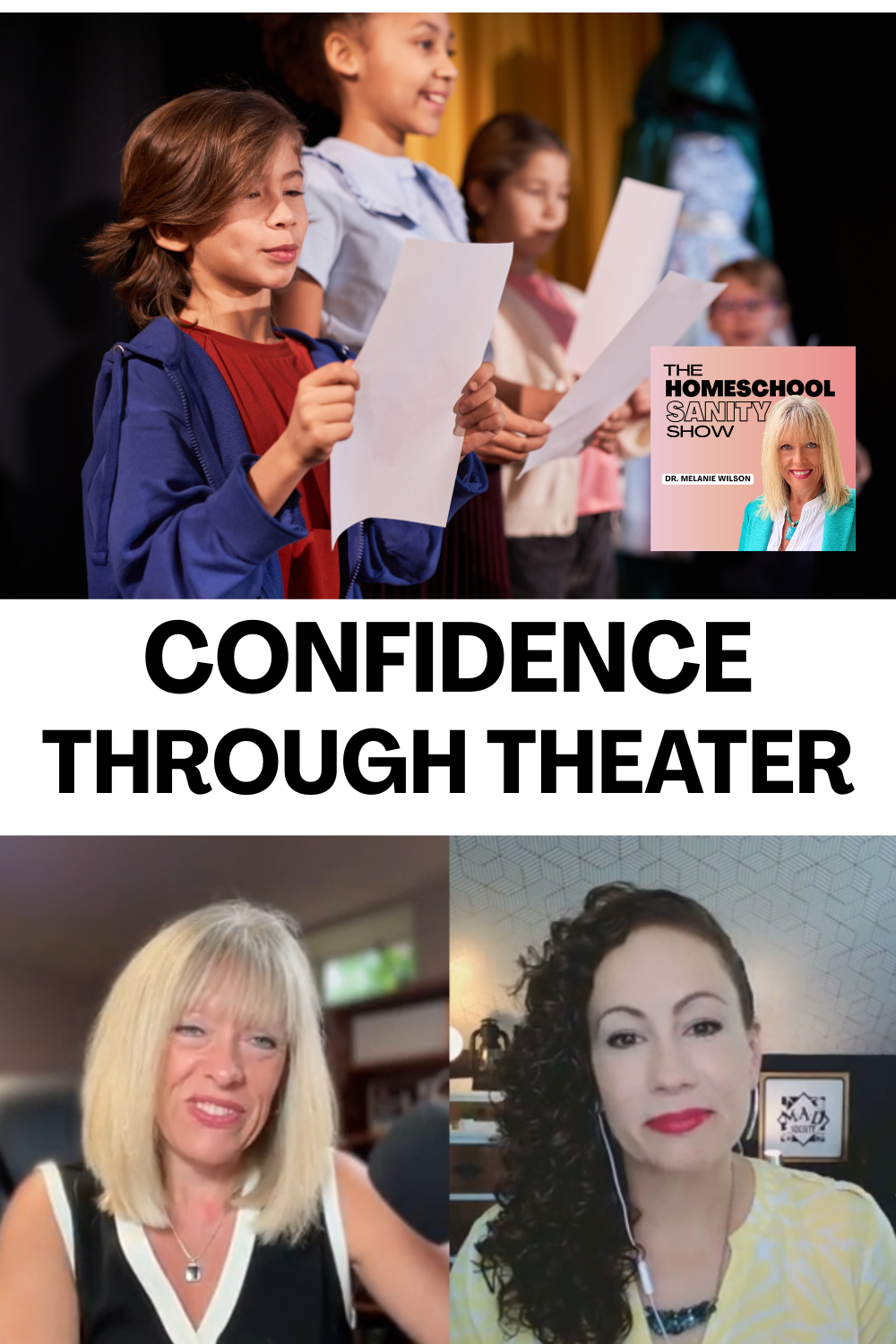
Special Replay: Teaching Kids Confidence with Homeschool Theater

🌿 This episode is proudly sponsored by Eden’s Table — a Christ-centered herbalism curriculum for K-5 homeschool families. One plant a week, woven through Bible, science, history, art, and Latin.

Try a free week →

If you have a child whose creativity and confidence you’d love to encourage, this episode is for you! I chat with Bethany Baldwin of MAD Society Inc. about her ingenious approach to homeschool theater:

🎭 The surprising benefits of theater—even if your child isn’t a “theater kid”

🛠️ How to start a homeschool drama club with zero experience

💡 Why student-led performances can spark confidence and creativity in every child

Ready to be inspired? Watch or listen now!

❤️ Melanie Wilson

Sponsor: CTC Math

Are you looking for a new Math Curriculum?

CTCMath specializes in providing online video tutorials that take a multi-sensory approach to learning. Favorably reviewed in Cathy Duffy’s 102 Top Picks and The Old Schoolhouse Crew Review, the lessons are short and concise to help your children break down concepts and appreciate math in a whole new way!

The lessons are taught the traditional way, not to a “test”.

Each one of the video tutorials is taught by an internationally acclaimed teacher, Pat Murray, who is renowned for teaching math concepts in a simple, easy-to-understand way (and in only a few minutes at a time). CTC Math uses a multi-sensory approach, having the combination of effective graphics and animation synchronized with the voice of a friendly teacher together with practical assessment. This three-pronged attack makes learning so much easier and more effective. Even students who struggled with math are getting fantastic results! And ones who were doing OK before are now doing brilliantly.

Visit ctcmath.com today to start your free trial.

__________________________________

Get your free lesson on making friends here:

https://funtolearnbooks.com/product/training-aliens-level-1-kit/

//WHAT TO WATCH / LISTEN TO NEXT

~ How to Start a Drama Club

~ Parent-Child Book Clubs for Homeschoolers

~ Family Entertainment for Building Relationships

~How to Teach Leadership

____________________________________

//RESOURCES

https://madsocietyinc.com

Bethany’s Instagram:

https://www.instagram.com/mad_society_inc/?igshid=OGQ5ZDc2ODk2ZA%3D%3D

Bethany’s TikTok

Bethany’s Facebook

https://www.facebook.com/people/MAD-Society-Inc/100094518963381

📸 Follow Melanie on Instagram to get regular tips and encouragement: https://instagram.com/homeschoolsanity

📚 Find sanity-saving, story-based curriculum kids love and productivity/organizational helps for you at Fun to Learn Books:

https://funtolearnbooks.com

Have a happy homeschool week!

Teaching Math the Easy Way (Special Replay)

🌿 This episode is proudly sponsored by Eden’s Table — a Christ-centered herbalism curriculum for K-5 homeschool families. One plant a week, woven through Bible, science, history, art, and Latin.

Try a free week →

Are you ready for math the easy way? Enjoy my special guest Pat Murray – he’s been a math teacher and coach for more than thirty-six years.Math The Easy Way – Episode 435

Special Replay

Are you ready for math the easy way? Enjoy my special guest Pat Murray – he’s been a math teacher and coach for more than thirty-six years.

And would you believe that Over that time, the programs and courses Pat and his company developed have helped students and families numbering in the tens and hundreds of thousands in more than seventy-two countries. So no matter where you live this information is accessible!

Pat and his beautiful wife Maree live in Sydney Australia, have 10 children, and 7 grandchildren – soon to be 8 (next month).

So, we are going to delve into seven of the most valuable tips for teaching math to kids –of all ages. I was amazed that your math programs have one low cost for a year, per family and it covers grades 1 through high school which is amazing and only a man with a big family understands what a blessing that is to parents with many children….

  1. Short concise explanations – clarity is important.
  2. Immediate practice – get them to practice it quickly and feedback.
  3. Rote learning memorizing, times tables, important facts. [Great examples given on the audio!]
  4. The sequence can make a difference. Start with the easiest stuff first, encourage success.
  5. Discovery and inquiring learning that is taught first by example.
  6. Puzzles and problem solving – a fun activity. Build interest.
  7. Parents – avoid frustration. Kids will avoid help, due.

Pat shares a mathematical trick – kids can learn as a parent to impress their kids.


Visit our sponsor:

Are you looking for a new Math Curriculum?

CTCMath specializes in providing online video tutorials that take a multi-sensory approach to learning. Favorably reviewed in Cathy Duffy’s 102 Top Picks and The Old Schoolhouse Crew Review, the lessons are short and concise to help your children break down concepts and appreciate math in a whole new way!

The lessons are taught the traditional way, not to a “test”.

Each one of the video tutorials is taught by an internationally acclaimed teacher, Pat Murray, who is renowned for teaching math concepts in a simple, easy-to-understand way (and in only a few minutes at a time). Using a multi-sensory approach having the combination of effective graphics and animation synchronized with the voice of a friendly teacher together with practical assessment. This three-pronged attack makes learning so much easier and more effective. Even students who struggled with math are getting fantastic results! And ones who were doing OK before are now doing brilliantly.

Visit ctcmath.com today to start your free trial.

AI Tips You Can Use This Week

AI Tips you can use this week

368: AI Tips You Can Use This Week

In this episode, Meryl shares a practical mix of AI tips you can implement right away.

What’s covered:

1. Ask Maps (Google Maps) Google Maps has a new AI feature called Ask Maps, currently rolling out. Instead of browsing categories, you can ask specific questions — gluten-free fast food nearby, a park within five minutes of a highway exit, a restaurant halfway between you and a friend. It understands your direction of travel and filters results accordingly.

2. Prompting — Where to Start If you’re new to AI tools and don’t know where to begin, start with purpose-built tools like Brisk (Chrome extension) or Magic School AI rather than jumping straight into ChatGPT or Claude. Both are designed for teachers but useful for homeschoolers, and they’ll give you a feel for what’s possible. Once you’re comfortable, you’ll likely want to move to the LLMs directly for more precise control.

3. Prompting — Leveling Up Be specific: give the AI a role, describe your outcome, set constraints (time, materials, age range, format). Then try this: tell it everything you can think of, and ask it what additional questions it needs answered. Letting the AI interview you often produces far better results than any prompt you’d write alone.

→ Grab the free list of 20 homeschool-specific prompts

4. Use One LLM to Prompt Another Before going into Gamma, Canva’s AI tools, NotebookLM, or any other AI-powered tool, go into ChatGPT or Claude first and ask it to write you the ideal prompt. Give it context, let it ask follow-up questions, then drop the finished prompt into your target tool. This works for custom Gems, vibe coding, slides — almost anything.

5. Connect Your LLM to Other Apps Both Claude and ChatGPT let you connect third-party tools like Canva and Gamma. Look for Connectors in Claude’s settings or the equivalent in ChatGPT.

6. Customize Your LLM’s Tone and Behavior Stop letting your AI flatter you. In ChatGPT, go to Settings → Personalization to adjust tone (Meryl chose “efficient,” turned down warmth and enthusiasm) and add custom instructions. In Claude, go to Settings → General and add your preferences.


Resources mentioned:


If you use any of these resources, come join the conversation in the Homeschooling with Technology Community on Facebook and let us know which ones your family enjoyed most!

Subscribe to the podcast so you don’t miss any episodes!

AI Tips you can use this week