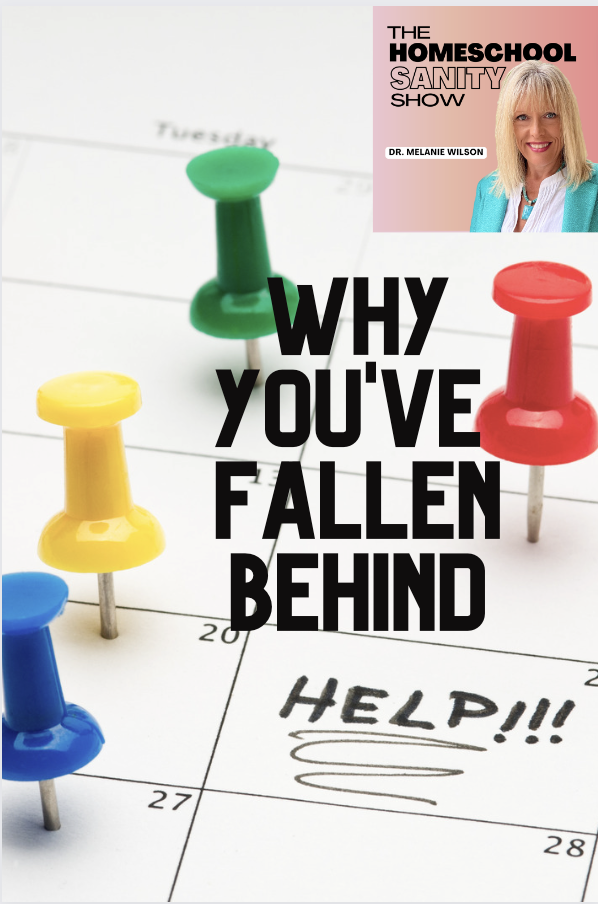
Special Replay: Why You’ve Fallen Behind In Your Homeschool Plan

🌿 This episode is proudly sponsored by Eden’s Table — a Christ-centered herbalism curriculum for K-5 homeschool families. One plant a week, woven through Bible, science, history, art, and Latin.

Try a free week →
📚 Part of our guide: Homeschool Burnout

Fallen behind in your homeschool plan? Learn how to get back on track with realistic planning, margin, and practical homeschool encouragement.How to Get Back on Track in Your Homeschool When You’ve Fallen Behind

A sanity-saving plan for overwhelmed homeschool moms

Have you fallen behind in your homeschool plan and now avoid opening your planner because it feels too discouraging?

You’re not alone.

In this episode of The Homeschool Sanity Show, Dr. Melanie Wilson explains why so many homeschool moms fall behind—even when they start the year with the best intentions—and what to do when your homeschool plan no longer matches real life. If you’ve ever looked at your lesson plans and thought, There is absolutely no way we’re getting all of this done, this episode is for you.

If you’ve been feeling behind, discouraged, or quietly tempted to pretend your planner doesn’t exist… this episode will help.

🎧 Listen now

More Episodes on Planning

Sponsored by CTCMath.com

Why Homeschool Moms Fall Behind

One of the biggest reasons homeschool plans unravel is something called the planning fallacy.

The planning fallacy is a common human thinking error that causes us to underestimate how long things will take, even when we’ve done them before and should know better. In homeschooling, that might look like:

  • assuming a science experiment will only take 30 minutes
  • believing you can finish two full language programs in one year
  • thinking you can get to co-op faster “this time”
  • forgetting how long math or writing lessons actually take

Dr. Wilson points out that many homeschool moms also deal with optimism bias—that tendency to believe that this time things will magically go more smoothly than they have in the past. And while optimism can be helpful, it can also lead to unrealistic homeschool planning.

Why Your Homeschool Plans Keep Falling Apart

If you’ve ever wondered, Why do I keep doing this to myself?—there are actually some understandable reasons.

According to the episode, homeschool moms often fall behind because they:

1. Plan using the best-case scenario

You assume every light will be green, no child will melt down, and the printer will behave.

2. Want to believe the plan will work

It feels better to make a hopeful plan than to admit you probably cannot do everything on your wishlist this year.

3. Misremember how long things took last time

You remember the math lesson taking 10 minutes when it actually took 20.

4. Assume this year will be different

You tell yourself:

  • I’m more organized now
  • The kids are older
  • This curriculum is easier

Maybe. But maybe not.

5. Plan too far ahead

It’s much easier to plan a realistic week than an idealized full school year.

6. Forget about interruptions

Homeschooling rarely happens in a vacuum. Life happens:

  • kids get sick
  • appliances break
  • dogs escape
  • people need help
  • emotions show up

That doesn’t mean you’re bad at homeschooling. It means you’re homeschooling in real life.How to Get Back on Track in Your Homeschool

The good news? You do not need to throw out your homeschool plan completely.

You just need a better one.

Here are the key strategies Dr. Melanie Wilson shares for getting back on track:

1. Plan Using the Worst-Case Scenario

Instead of assuming everything will go perfectly, estimate based on what usually happens on a normal or difficult day.

A simple way to do this:

  • estimate how long something should take
  • then double it
  • or at least split the difference between best case and reality

If a science experiment “should” take one hour, plan for two—or at least one and a half.

That may feel pessimistic, but it’s actually more honest and much more useful.

2. Accept That You Can’t Do Everything This Year

This one stings a little—but it’s freeing.

Sometimes the best way to get back on track is to stop trying to fit everything into this school year.

Instead:

  • make a list of “not this year” ideas
  • save great projects or extras for later
  • choose what matters most right now

That doesn’t mean you’ve failed. It means you’re prioritizing.

3. Start Timing Your Homeschool Activities

One of the easiest ways to plan more realistically is to stop guessing.

Try timing:

  • your math lessons
  • science labs
  • writing assignments
  • read-aloud time
  • transitions between subjects

This gives you actual data instead of wishful thinking.

And yes… it may be mildly humbling 😅
But it’s incredibly helpful.

4. Learn From Last Year Instead of Ignoring It

Ask yourself:

  • What consistently slowed us down last year?
  • What took longer than I expected?
  • What parts of our day always felt harder than planned?
  • What routines still aren’t working?

If your homeschool day still tends to start late…
If your kids still dawdle…
If you still hate setting up science supplies…

That matters.

Past patterns are often better predictors than future hopes.

5. Plan for the Short Term

If yearly planning keeps overwhelming you, try shifting to:

  • quarterly planning
  • monthly planning
  • weekly planning
  • even daily planning if needed

Short-term planning can feel more manageable and more realistic.

It also gives you a chance to adjust before things spiral too far off course.

6. Build Margin Into Your Homeschool Plan

This may be the most sanity-saving strategy of all.

Dr. Wilson encourages homeschool moms to leave margin in their plans—intentional open space for the unexpected.

That might look like:

  • leaving one hour unscheduled each day
  • keeping one lighter day each week
  • leaving one week open each month
  • creating “catch-up” space instead of packing every day full

This is so important because real life always shows up eventually.

And when it does, margin helps you recover without feeling like the entire year is ruined.

What to Do If You’re Already Behind in Your Homeschool

If you’re already behind, here’s your gentle reset plan:

Start here:

  • Open the planner
  • Don’t panic
  • Don’t try to catch up on everything at once

Then:

Ask:

  • What absolutely still needs to happen this year?
  • What can be simplified?
  • What can be dropped?
  • What keeps getting in the way?

Then do this:

  • revise your expectations
  • shorten your planning window
  • add margin
  • move forward from today, not from where you “should” be

That’s how you get back on track.

Not with guilt.
Not with overloading tomorrow.
But with a better plan.


Final Encouragement

Falling behind in your homeschool plan doesn’t mean you’re failing.

It usually just means your plan was built for an ideal life… and you’re living a real one.

The goal is not to create a perfect homeschool year.

The goal is to build a homeschool life that actually works.

And that starts by planning with reality, grace, and a little more margin.


Have a happy homeschool week!

Be sure to subscribe to the show for regular updates and planning resources!

New Here? Start with These Episodes

Start Your Homeschool Day Right: Morning Routines That Set the Tone for Success

📚 Part of our guide: Homeschool Organization

Start each homeschool day with peace and productivity! In this episode of Vintage Homeschool Moms, Felice Gerwitz shares practical tips, routines, and a quick self-evaluation quiz to help you create a joyful, well-structured homeschool day.What are your goals for this school year? I bet you want a great start to your homeschool day, and in this podcast, we discuss ways to take control of the chaos or schedule overload and enjoy a successful day every day. Join your host, Felice Gerwitz, and listen in for key points and a quick quiz to get you started. A Great Start to Your Homeschool Day

Thanks to our sponsor! CTCMath.com – yes, they are an amazing math company and I can attest to it as my grandchildren and now using it and love it.

Your Homeschool Day ~ Episode 565

Whether it’s day one, day 21, or day 101, each homeschool day offers a fresh start. Over the years, I’ve learned that our attitude shapes how the day begins and, ultimately, how it ends. Our children pick up on our cues, and while that may feel like a lot of pressure, it’s valuable to keep in mind. A positive mindset can set the tone for a productive and joyful day.

I begin each day with prayer, praising God for having a way of turning my day around. I keep that mental praise going even when I don’t feel like being thankful, and especially when all appears to be going south. You get what I mean! As moms, we carry many burdens and wear many hats. But praising God is a sure way to get your day off to a good start. So, once you get your mental work down, what about the physical?

Relevant Past Episodes

For more insights on creating a great homeschool year, check out these Vintage Homeschool Moms episodes:

  1. Best Homeschool Planning Tips (Episode #214): Learn simple planning tips to start your year strong, focusing on balancing school with life using checklists and goal-setting strategies.
  2. Dejunking and Homeschool Organization Felice and Meredith Curtis share years of experience in homeschooling, and now, they discuss great tips for getting your life organized and not losing those precious treasures or important documents.

Homeschool Day Reality

Do you have routines, a schedule, or another method to navigate your homeschool day? If your days feel chaotic, consider revising or implementing a structure. Routines always worked best for me, but I also used a structured schedule for academic classes tailored to my children’s grade levels. These were completed daily, alongside weekly goals. Checklists were incredibly helpful for staying organized and ensuring progress. You can find useful printable planners and checklists at mediaangels.com/store to support your homeschool journey.

By blending routines for flexibility and schedules for accountability, you can create a balanced day that suits your family. Start each morning with intention, and watch how small changes transform your homeschool experience into one that’s both effective and enjoyable.

Just for fun, I have a quick self-evaluation for you to take. Typically, I’m not a fan, but this will help you figure out where you can improve your day. And, with improvement comes success, happiness for a job well done, and for me, a sense of accomplishment. Many times, we struggle without putting our finger on the “why” behind the problem. In this way, taking a quick assessment may be just what you need to figure out what you can do, incrementally, to create a well-run homeschool day!


Homeschool Day Self-Evaluation Quiz

This True or False quiz helps homeschool moms assess their daily structure. Answer honestly based on your typical day to determine if it’s chaotic, scheduled, routine-based, rigid, over-scheduled, or working well. Mark True (T) or False (F) for each of the 20 questions.

    1. My homeschool day often starts late due to rushing.
    2. I follow a fixed timetable for subjects (e.g., math from 9-10 AM).
    3. We have consistent habits, like morning chores before lessons, but adjust times.
    4. I stick to the schedule even if interruptions, like a child’s question, arise.
    5. Our day is packed with back-to-back activities, lessons, and errands.
    6. Mornings feel productive and calm, setting a positive tone.
    7. Unexpected events, like spills or tantrums, derail the entire day.
    8. I use daily checklists for academic goals, completed at my kids’ pace.
    9. We have flexible learning blocks, but the order stays consistent.
    10. Plan changes, like skipping a subject, make me anxious.
    11. Afternoons feel exhausting from too many co-ops, sports, or extras.
    12. Our homeschool rhythm allows time for work and fun.
    13. I often skip subjects due to no clear plan.
    14. We set and track weekly goals with planners or apps.
    15. Daily rituals, like reading aloud after lunch, keep things steady.
    16. I rarely deviate from the agenda, even for teachable moments.
    17. We cram in multiple subjects and outings, leaving no downtime.
    18. I feel satisfied daily that we’ve accomplished what matters.
    19. Mornings are unpredictable, with kids scattered and no clear start.
    20. We have a structured outline but include buffers for flexibility.

Free Download – Homeschool Matters


Answer Key and Interpretation

Count your “True” answers for each category. The category with the most “True” responses likely describes your homeschool day (ties suggest a hybrid style). Below are explanations and suggestions inspired by homeschool practices like routines, schedules, and checklists.

  • Chaotic Day (Questions 1, 7, 13, 19): 3+ True = Your day lacks structure, causing stress. Suggestions: Start with simple routines, like a fixed morning start. Use checklists from mediaangels.com/store for organization. Set a positive tone with a family huddle.
  • Scheduled Day (Questions 2, 8, 14): 2+ True = You have a predictable academic timetable. Suggestions: Add flexibility with weekly goals alongside daily slots. Use grade-appropriate checklists for tracking. Blend in routines for non-academic tasks if too strict.
  • Routine-Based Day (Questions 3, 9, 15): 2+ True = Your day flows with adaptable habits. Suggestions: Enhance with light scheduling for core subjects. Use chore charts or goal sheets from mediaangels.com/store. Include breaks to avoid burnout.
  • Rigid Day (Questions 4, 10, 16): 2+ True = Your structure may be too inflexible. Suggestions: Add buffers (e.g., 15-minute flex time). Shift to routines for daily habits, keeping schedules for academics. View deviations as opportunities, using checklists for priorities.
  • Over-Scheduled Day (Questions 5, 11, 17): 2+ True = Your day is packed, risking exhaustion. Suggestions: Cut non-essentials to 4-5 core activities daily. Add downtime routines, like quiet reading. Use planners from mediaangels.com/store to streamline.
  • Working Well Day (Questions 6, 12, 18, 20): 3+ True = Your day is balanced and enjoyable. Suggestions: Maintain with monthly reviews. Combine routines and light schedules. Share positive cues with kids and explore mediaangels.com/store for tools.

If answers are mixed, try a hybrid approach: routines for flow, schedules for academics, and checklists for accountability. You can take this quiz at different times during the year, so bookmark this podcast to review at another time. Next week, we will tackle Fine-Tuning Your Homeschool Day: Balancing Structure and Flexibility. This builds on today’s topics with some quick takeaways to help your busy day run smoothly.

For more tips, listen to Vintage Homeschool Moms podcast episodes on organization.

Special Replay: Organizing Challenges for the New Year


Organizing is a popular goal for the new year. If you’re a homeschooler wanting to get organized, it can be hard to know where to start. Consider the six areas I share in this podcast episode.

SPONSOR: NOW Programs

Have a child with learning challenges? NOW Programs offers help.


Want to read the podcast as a blog post? READ HERE or SUBSCRIBE ON ITUNES or ON STITCHER

Links

Airtable.com

a comprehensive post about the best places buy/sell used curriculum

Konmari method  for folding clothes

Plan to Eat

Tastefully Simple’s 30 day meal plan

free meal planning book

The Organized Homeschool Life

theorganizedhomeschoollife_2piecemockup


Which area are you organizing first? Let’s chat about it on Facebook.

Tips and Tools to Organize Your Homeschool for Insanely Easy Planning

homeschool organization tips

Are you a homeschool mom gearing up for a new school year? Or perhaps you’re considering homeschooling for the first time? No matter where you are on your homeschooling journey, one thing’s for certain – staying organized is key to a successful and stress-free experience. Homeschool organization doesn’t have to be hard.

In this article, we’ll explore a plethora of great ideas, tips, and tools to help you create an organized and efficient homeschooling environment, even in small spaces like your living room or kitchen table. Plus, we’ll provide you with some fantastic ideas for homeschool organization that will make planning a breeze. Get ready to streamline your homeschool!

1. Create a Dedicated Homeschool Space

While a dedicated homeschool room is ideal, it’s not always possible. Instead, designate a specific area in your home, whether it’s a corner of the living room, the kitchen table, or even a cozy nook in the dining room. This helps create a focused environment for learning and ensures that your homeschool supplies are easily accessible. A dedicated space may be all over Instagram, but you homeschool in your home, so create a homeschool storage system that makes sense for you, even if it’s the dining room table.

2. Utilize Small Spaces Efficiently

For homeschooling in small spaces, think vertically and use wall space for storage. Install shelves, pegboards, or wall-mounted storage units to keep art supplies, craft materials, and books neatly organized. Milk crates and wicker baskets can also be stacked or hung to create storage pockets for various items. The organizational system that works best is the one you’ll actually use.

3. Invest in Practical Storage Solutions

Storage bins, supply caddies, and glass jars are your best friends. Use clear glass jars to store art supplies, small items, or craft materials. Label storage bins for different subjects or grade levels and consider using different colors for easy identification. Keep in mind your younger children will need easy access to craft supplies in any given week. Creating a great place takes a little time, but you can make it your own space.

4. Establish a Homeschool Planner

A homeschool planner is a must-have. It can be a physical planner or a digital tool. Use it to jot down lesson plans, homeschool days, and weekly assignment sheets. This will keep you on track and ensure that nothing falls through the cracks. Teacher planners are great for homeschool families who need to keep track of a child’s assignments, kids’ work, and a homeschool schedule. Student planners, especially for high school, are great if you’re using a digital homeschool curriculum that has a typical week, easy steps, and to-do lists. Daily work can be tracked and simple tips for your student to make the most of the planner can go a long way. A good fit when homeschool planning is, at the end of the day, the one that works for you.

5. Morning Basket and Routine

Kickstart your homeschool day with a morning basket. Gather language arts materials, engaging books, and any other resources you want to cover as a family. This is a great way to ease into the day and cover subjects that all your kids can enjoy together. You can create a little basket for each of your younger grades and your young children can take ownership over their homeschool books. During morning time, you can relieve some of the overwhelm and amount of time it takes to get focused. Think of your daily plan when setting up this type of homeschool area, what extra space you might have, and the different ways you can create the perfect spot.

6. Individual Workstations for Older Children

If you have older kids, consider providing each child with their own desk or workspace. This encourages independence and responsibility. They can keep their textbooks, notebooks, and assignments organized in their designated space.

7. Use Chalkboard Paint and Whiteboards

Chalkboard paint or adhesive whiteboards can transform any wall into an educational space. Use it to display the weekly schedule and important dates, or even as a creative outlet for kids to express themselves. And a bonus during family game nights is the ability to grab those lap-sized whiteboards for tracking scores, etc. #winwin

8. Keep Teacher Manuals and Resources Handy

Designate a shelf or a file folder system to store teacher manuals, curriculum resources, and educational materials. This will save you time searching for materials during school time when you need to access those file folders. This can help make homeschool organization a breeze.

9. Plan Meals and Breaks Ahead

Meal planning is a game-changer. Prep meals in advance to save time during the day. Incorporate regular breaks and physical activity into your schedule to keep your homeschool family refreshed and energized. One of the best things about homeschooling is the freedom to incorporate real life into your favorite homeschool organization ideas.

10. Regular Homeschool Records and Evaluations

Set up a system for keeping track of your homeschool records, including assignments, completed work, and any assessments. This will help you gauge your child’s progress and make adjustments as needed. At the start of the new homeschool year, think ahead to the type of records you’ll need to keep and the different methods available to you to track and document.

Incorporate these homeschool organization tips into your routine to ensure a smooth and successful homeschooling experience. Remember, what works best will depend on your family’s unique needs and preferences, so feel free to adapt and modify these ideas to create the perfect homeschool space for your family. Happy homeschooling!


Get Your FREE Monthly Planner & have Homeschool Organization Help At Your Fingertips!


Organizing Digital Homeschool Resources

Organizing Digital Homeschool Resources

219: Organizing Digital Homeschool Resources with Brooke Poston

Our guest in this episode is Brooke Poston from Homeschool Resource Co who has some great tips to share on organizing digital homeschool resources.

Brooke explains what she means by digital resources and supplemental content and where one can find this content. She then details how to create an inventory spreadsheet to keep track of everything.

Finally, she breaks down the 3 main ways to organize content and the benefits and drawbacks of each.

Listen to the episode for some easy-to-implement ideas.

The workbook and course on Digital Organization Brooke mentions

The digital resources Meryl mentions are

—————————————————————————————————————-
Take a look at show sponsor, FundaFunda Academy to see what they offer for online classes and web-based unit studies.

Join our Facebook Group especially for the listeners of this podcast! You can ask questions and get advice as you try integrating technology in your homeschool.

If you enjoyed this episode, please subscribe to the show and give a rating and maybe even a review! Subscribing will help you make sure you never miss an episode

Organizing Digital Homeschool Resources

Best Of HomeschoolCPA: Board Binder: Board Training All Year Long

Board Binder: Board Training All Year Long for Homeschool OrganizationsIn the new Board Member Manual, Carol Topp, CPA offers has important topics your board should discuss every year. Make a plan to cover one topic a month and do board training all year long. She shares those topics on today’s podcast.


Visit Carol’s website here!


FEATURED PRODUCT from HomeschoolCPA:


Homeschool Organization Board Manual

This is a real life conversation:

HomeschoolCPA: Do you have a copy of your EIN letter form the IRS?
Homeschool Leader: No. It was gotten by a former treasurer 15 years ago. All I have is the number handwritten on a sheet of paper from the bank.
HomeschoolCPA: Do you have a copy of  your Articles of Incorporation filed in your state?
Homeschool Leader: No; I don’t think so.
HomeschoolCPA: Has your homeschool group ever applied for tax exempt status with the IRS?
Homeschool Leader: I have no idea! All I was given when I took over leadership was the checkbook. 🙁

This is a sad, but true reality. Sometimes current group leaders have none of the important paperwork for their organizations.

Homeschool board  members should keep all their organization’s important papers in a safe and accessible place. Usually, a 3-ring binder works well.

The Homeschool Organization Board Manual comes in a Word file to make it easy for you to customize it for your organization.

The manual (a digital file) costs $9.95, but you only purchase one copy for your organization.

You are allowed to print off copies of the Manual for all of your board members, but please do not share the original Word file with them. And do not share the original Word file with other people, email it or post it on the internet. TIA!

Click Here to request more information!


Save

Evernote Online Filing System

Evernote Online Filing System

84: Evernote online filing system with Rachel van der Merwe

The guest for this episode is Rachel van der Merwe, a Ph.D. candidate in media studies at the University of Colorado Boulder. Rachel has four years of teaching experience at the undergraduate level and currently teaches the upper-level course Media and Popular Culture for CU Boulder. She is also my daughter and the teacher of the Visual Literacy class for show sponsor, FundaFunda Academy.

What is Evernote?

The Evernote app describes itself as a digital notebook, but Rachel thinks it’s more helpful to think about Evernote as a digital extension of your memory—an external hard drive or archive for the central processing unit that is your brain.

Evernote for Homeschoolers

Evernote has many uses within the context of homeschooling, or really any educational setting,

Some useful features are:

1. You can take a photo of a page of notes, or business cards at a homeschool convention, and save it as a note

2. You can create notebooks for each course, inside the notebook

  • Drop any articles/PDFs/lesson plans
  • Drop in audio files and images too
  • Use Tags “to read” “read” or on the subject matter or content
  • Can add reminders to notes

3. You can take notes in notes
EN has its own annotation system built-in. You can open up a PDF and highlight, underline, jot down notes, draw arrows, etc in an assortment of colors OR you can open the PDF in Adobe Acrobat or Preview, annotate there, and when you save and close the PDF it automatically saves to the file in Evernote.

4. Organization

  • Notes are stored in notebooks, notebooks can be placed in stacks
  • Each notebook can be private or shared.
  • Each student could have a notebook for each class and maybe your kids would organize their notebooks in separate stacks for each semester.
  • You as a parent could have stacks for each of your kids

5. Relocating info
You can find items you have saved using

  • notebooks/stacks
  • tags and geo-tags
  • dates

With Evernote Premium, everything is OCRed and becomes searchable – even handwriting!

6. Evernote Web Clipper
Whenever one comes across something online, clip it and tag with specific keywords and choose which notebook to add it to.

If you want your teens to learn how to use it, this is one of the resources covered in FundaFunda Academy’s Computer Applications class.

Join our Facebook Group especially for the listeners of this podcast! You can ask questions and get advice as you try integrating technology in your homeschool.

If you enjoyed this episode, please subscribe to the show and give a rating and maybe even a review! Subscribing will help you make sure you never miss an episode.

Evernote online filing system

Tool Time

Tool Time|Back to HomeschoolTool Time

Podcast #55

It’s that time of year again! Back to Homeschool!  This makes it Tool Time.. Who else is excited? It’s always fun to get ready for the new year. Kids enjoy it as much as parents! Don’t go into the new year unprepared! In this episode, we take a look at the tools you need to get ready to tackle the near year. Whether you are new to homeschooling, or a veteran, we have you covered. What should you fill your “tackle box” with? What do you need to do to get ready? We go over the list of items you might want to have in your arsenal.

Plus, there is something so fun about picking out new school supplies and having all of your household areas covered and ready to go! Get the kids involved. Let them help make a list of items you need to pick up. It is fun for younger kids to pick-out their own supplies (with mom’s help, of course)

Some of the tools you may need:

  • Crayons
  • Colored Pencils
  • Washable Markers
  • Pencils
  • Pens – colored and black/blue
  • Pencil pouches
  • Notebooks
  • Notebook paper
  • Graphing Paper
  • Construction paper/Colored Paper
  • 3×5 cards
  • Binders
  • Erasers
  • Pencil Sharpeners
  • Rulers
  • Scissors
  • Laminator and laminating sheets
  • Backpack
  • Glue/Glue Sticks
  • Folders
  • File Folders
  • Tape
  • Staplers
  • White Out
  • Post-it Notes
  • Journals
  • Composition Notebooks
  • Planners
  • Calculators – graphing or regular
  • Laptops/tablets/Computers
  • Appropriate software and apps

Also important tools:

  • Co-op and support group memebrships _ You can find co-ops and support groups here www.FPEA.com/groups
  • FPEA Membership

Here are a few links that can help you with your shopping:

https://www.walmart.com/cp/back-to-school/1071204

https://www.goodhousekeeping.com/life/parenting/tips/a17427/school-shopping-lists/

https://www.target.com/c/school-office-supplies/-/N-5xsxr

The above lists should give you the help you need to find the right tools to get you on the right track this year! We hope that you are as excited about the new year, or refreshing your year, as we are!

Join us this September in Sanibel Island for both fun and learning. Make a staycation of of this FPEA STEM Conference. Sanibel is a beautiful area with lots to explore.

Sanibel STEM

Board Binder: Board Training All Year Long

Board Binder: Board Training All Year Long for Homeschool OrganizationsIn the new Board Member Manual, Carol Topp, CPA offers has important topics your board should discuss every year. Make a plan to cover one topic a month and do board training all year long. She shares those topics on today’s podcast.


Visit Carol’s website here!


FEATURED PRODUCT from HomeschoolCPA:


Homeschool Organization Board Manual

This is a real life conversation:

HomeschoolCPA: Do you have a copy of your EIN letter form the IRS?
Homeschool Leader: No. It was gotten by a former treasurer 15 years ago. All I have is the number handwritten on a sheet of paper from the bank.
HomeschoolCPA: Do you have a copy of  your Articles of Incorporation filed in your state?
Homeschool Leader: No; I don’t think so.
HomeschoolCPA: Has your homeschool group ever applied for tax exempt status with the IRS?
Homeschool Leader: I have no idea! All I was given when I took over leadership was the checkbook. 🙁

This is a sad, but true reality. Sometimes current group leaders have none of the important paperwork for their organizations.

Homeschool board  members should keep all their organization’s important papers in a safe and accessible place. Usually, a 3-ring binder works well.

The Homeschool Organization Board Manual comes in a Word file to make it easy for you to customize it for your organization.

The manual (a digital file) costs $9.95, but you only purchase one copy for your organization.

You are allowed to print off copies of the Manual for all of your board members, but please do not share the original Word file with them. And do not share the original Word file with other people, email it or post it on the internet. TIA!

Click Here to request more information!


Save

Best Shows Replay: How to Get Organized with the FLYLady

Homeschool FLYing: Get Organized with the FLYLady podcast; The Homeschool Sanity ShowHow to get organized with the FLYLady

While Melanie is on vacation this month, we have a few of her best episodes scheduled! Do you want to learn how to get organized with the FLYLady?

I am so excited about this episode of the Homeschool Sanity Show and if you have struggled to get organized like I did when I started homeschooling 16 years ago, I think you will love my interview with Marla Cilley, the FLYLady. Even though I’ve been FLYing for years, I found myself incredibly motivated to make this year an even more orderly one after chatting with her.

If you share my enthusiasm for homeschool organization, I think you’ll love my new book, The Organized Homeschool Life. It will help you organize your entire homeschool life 15-minutes at a time.  

The Organized Homeschool Life | how to get organized with the FLYLady

Links

Sink Reflections

Body Clutter

FlyLady & Friends podcast

Amy Kuddy TED Talk

Simply Homeschooling with Tami Fox

Homeschool Teacher Control Joural

Little Hands to Heaven Preschool curriculum (15 minutes at a time)

FLYLady Events page

The Power of Homeschool Routines with FLYLady


Have a happy homeschool week!