Sweet 13 Bonus: It Is Lab Science and You Are Not a Scientist

Creation Science Podcast | Sweet 13 Bonus Episode

The Ultimate Homeschool Podcast Network turns thirteen this month. To celebrate, every host on the network answered one real question from a homeschool parent — thirteen questions, one episode, running on every feed.

One of those questions is the one you already know: “It is lab science, and you are not a scientist.”

It is the fear that arrives the year a kid hits high school, and it is the reason this show exists. Felice Gerwitz wrote the science curriculum before she ever built this network — so when that question comes up in the birthday episode, it points listeners straight here, to the Creation Science Podcast.

If that is you, start anywhere in this feed. There are years of it.

Also in this episode: Felice Gerwitz on whether to homeschool at all · Hal and Melanie Young on boys who will not sit still · Dr. Melanie Wilson on why you are already behind · the 7Sisters on the high school transcript · Sue Myers on a fever and a two-year-old · Meryl van der Merwe on teenagers and AI · Meredith Curtis on getting the joy back · Lisa Nehring on life skills before they launch.

🎂 The Sweet 13 Giveaway is open. More than $1,500 in prizes, four drawings across October, and a free party favor for everyone who enters. Enter at ultimateradioshow.com/sweet-13 — October 1 through 29. No purchase necessary, US residents 18+, official rules here.

Presented by Eden’s Table. Use code EDEN13.

Setting Up a Science Lab in Your Homeschool

Setting up a science lab in your homeschool on a shoestring budget in no time at all.

Setting Up a Science Lab in Your Homeschool

Experiments don’t have to come from ready made kits. You can be about the business of setting up a science lab in your homeschool.

There are many great experiment books that require materials you can find at home. For example, your an make an electric motor using magnets, batteries, cork, pins, a knitting needle, copper wire, clay, a small base of wood, a knife, and tacks. Most of us have these things in our home. A ready made kit isn’t ncessary.

Plan to organize your science lab supplies

There are many sources for lab supplies, but my favorites are the do-it-yourself kind.  You can use tackle boxes, plastic totes, and even pencil boxes to store your lab supplies. Keeping these items on hand saves money in the long run.

Finding materials for your homeschool science lab

There are many places you can find even the hardest to find materials. The hardware store, an arts supply store, an electronics store, and of course- Amazon. But, what do you buy? What do you need to have on hand?

Lab equipment on a shoestring budget…

  1. large magnifying glass
  2. eye droppers
  3. coffee filter paper
  4. thermometer
  5. labels
  6. candles
  7. baby food jars
  8. spice jars
  9. heat-proof measuring cups
  10. measuring spoons
  11. a balance
  12. kitchen scale
  13. funnels
  14. sieve
  15. timing device
  16. metal spoon
  17. scissors
  18. sharp knife
  19. small brushes
  20. string
  21. paper
  22. pencils

Biology, chemistry, and physics use the above list and additional specialized equipment. A non-comprehensive list includes:

  • tweezers
  • sharp metal pick
  • plastic tubing
  • flashlight
  • microscope
  • dissecting kits
  • petri dishes
  • Bunsen burner
  • safety goggles

For a comprehensive list, I recommend my book, Teaching Science and Having Fun.

Creating a Safe Place for your Homeschool Science Lab

While much can be done at the kitchen table, there are some special considerations to take when performing experiments and setting up your lab. I recommend:

  • a clutter free space that is well lit
  • the kitchen or bathroom sink ready with soap, water, towels, and free of dishes, etc.
  • keeping a basket with emergency things such as a small fire extinguisher, eye wash,  goggles, and non-latex gloves
  • kitty litter to get spills up quickly
  • a chemical mask
  • a basic first aid kit
  • a carpet free flooring

Setting up a science lab in your homeschool doesn’t have to be expensive or complicated. With a little planning you can have one ready to go!

Check out the NEW! Creation Science Podcast channel on the Ultimate Homeschool Radio Network!

________________________________________________________________________________________________________________________________________________________


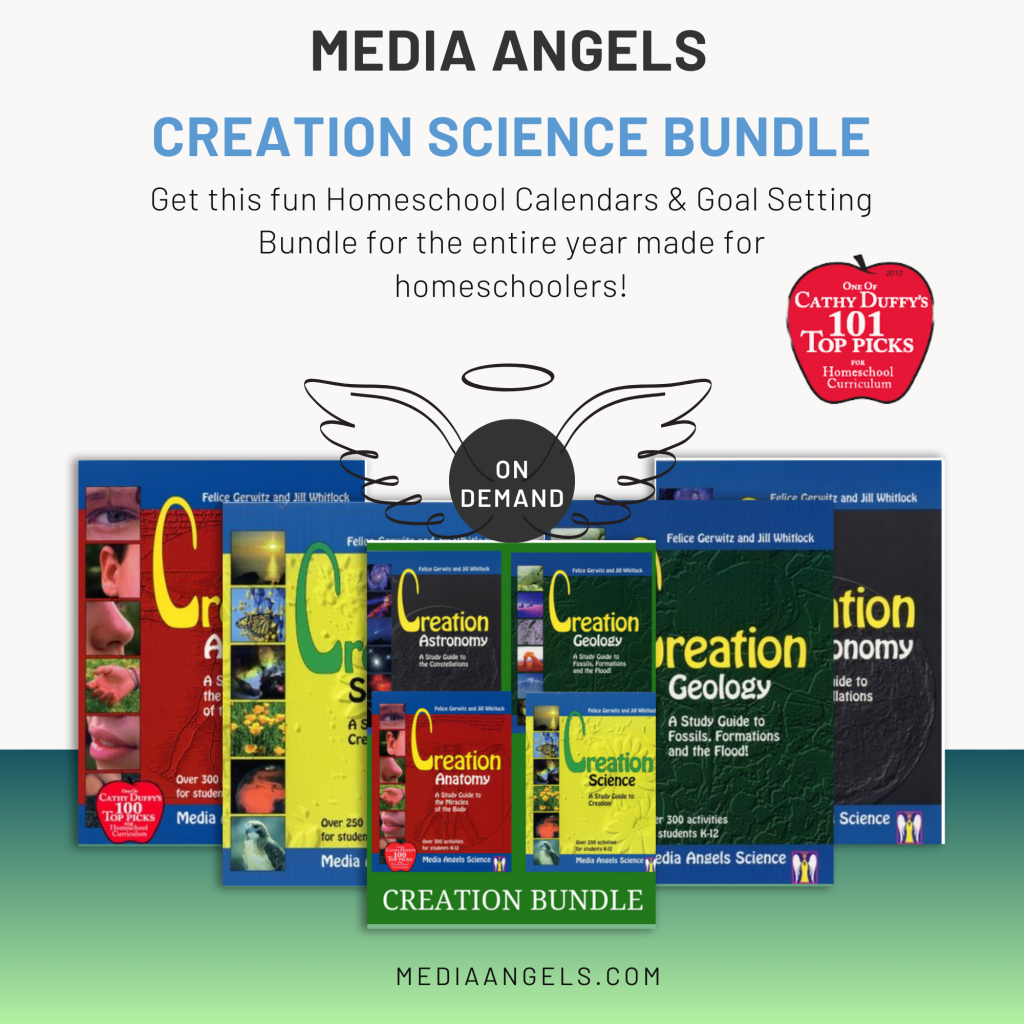
Media Angels Creation Bundle Membership Site


Get an entire K-12 Creation Science Curriculum for less than $70.

About Our Books:

Why should you teach your children about Creation? Because everything else they read that is remotely science related teaches evolution as FACT. Shouldn’t your children learn there is more than one side to the story? We do and we consider this our mission at Media Angels.

About the Study Guides:

These study guides include a readable outline of the main points in the Creation vs. evolution discussion, the major talking points you should know and ways to educate the children in these points with hands-on activities and experiments. This series isn’t a read-it-one-time and forget it!

If you want a course in Creation Apologetics for kids, this is it!

Additional Resources

Activity Packs for each of the study guides which contain hands on activities you can photo copy for your family.

Creation Kids Classes: On Demand

-Six weeks worth of classes — one per week for ages K-8th grade (high school if you’ve never studied Creation).
-Audio Recordings
-Handouts and Websites to visit
-Further research
-Bonus interviews

media angels membership subscribe button